
Why was “The Art of Fugue” written in D minor?
<Hypothesis> For Bach, D minor was the only possible key for this collection. This was not merely a matter of preference; it was likely a conclusion derived from a dual necessity: the physical structure of the keyboard and the nature of the minor scale system.
1. The absolute symmetry of “D” on the keyboard
The arrangement of white and black keys on a keyboard instrument exhibits perfect mirror symmetry at only two points: the note D and the note G♯/A♭. Counting semitone intervals with D as the center (0), D♯ (+1) and C♯ (-1), as well as F♯ (+4) and B♭ (-4), form precise mirror pairs, while G♯/A♭ (±6) serves as the axis itself—a self-symmetrical point at the tritone. If any other note were chosen as the center, the white and black keys would not correspond so neatly. In other words, D was virtually the only choice as a foundation for Bach to execute contrapuntal inversion (inversion of the melodic line) without structural breakdown.
2. A rare quality: remaining “within a mode” even when inverted
When the natural minor scale of D minor (D-E-F-G-A-B♭-C-D) is strictly inverted around the D axis, the resulting scale is D-E-F♯-G-A-B-C-D—that is, D Mixolydian. Crucially, this does not result in a “bizarre sequence of chromatic notes outside the key” but remains a coherent, natural musical mode. While a similar phenomenon occurs if the same operation is performed on a major key (for example, inverting C major around C yields C Phrygian)—meaning this property is not exclusive to the minor key—the minor key possesses an additional asset that the major key lacks.
3. The Flexibility of the “Dual Scale” in Minor Keys
Minor keys possess two “faces”—the natural minor scale and the harmonic minor scale—which differ in their treatment of the leading tone. While the seventh degree (C) remains unchanged in the natural minor scale, it is raised by a semitone to C♯ in the harmonic minor scale to serve as a leading tone. This ability to switch between two scales was likely the key to making the mirror fugue possible; major keys lack a corresponding structural duality.
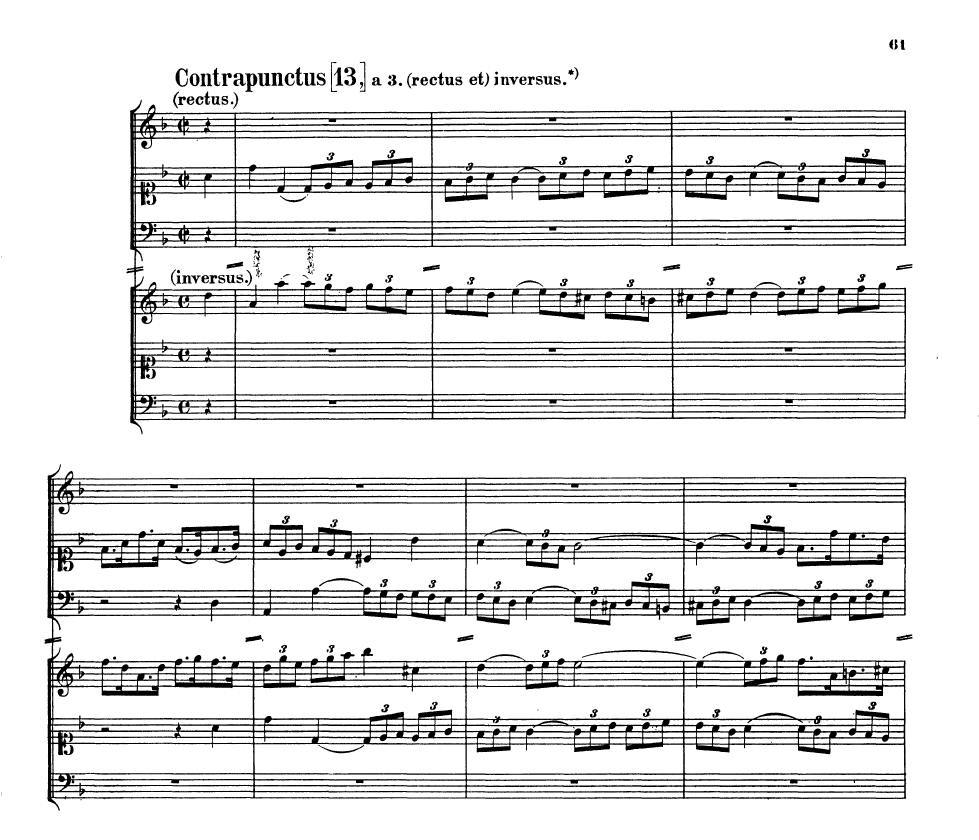
In fact, the subject of the mirror fugue is thought to be inverted not around the tonic (D) itself, but around an axis (mirror) positioned between F and G. Adopting this axis causes the tonic (D) and dominant (A) to swap vertical positions, while the harmonic minor’s leading tone, C♯ (a semitone below D), corresponds to B♭ (a semitone above A)—the matching point on the subdominant side. Indeed, an analysis of “Contrapunctus XII” confirms that where the “rectus” (original form) modulates to A minor (the dominant key), the “inversus” (inverted form) modulates to G minor (the subdominant key); the dominant and subdominant degrees are neatly swapped through inversion—a correspondence made possible only by the interplay between the natural and harmonic minor scales.
However, actual score analysis (such as the study of “Contrapunctus XIII” by teoria.com
) points out that the voices are not all inverted uniformly around a single axis; instead, different axes are used for different voices. Therefore, the explanation that “the axis lies between F and G” should be viewed not as a single principle governing the entire piece, but rather as a representative example among several possible methods of realization.
4. Conclusion
A coherent mirror fugue is possible only when three conditions are met: the physical structure of the keyboard is symmetrical around the note D; the natural minor scale of D minor remains a natural mode even when inverted; and the practice of alternating between two scale forms—characteristic of the minor mode—provides the necessary flexibility for the inversion operation. Since the major mode fundamentally lacks this third element of flexibility, D minor was the only choice for the “proof of the universal laws of counterpoint” that “The Art of Fugue” sought to demonstrate. #baroque #bach #fugue #mirror #contrapuntus #片山俊幸