Bach: Toccata, Adagio and Fugue in C Major, BWV 564 / Helmut Walcha et al.
In keyboard music, a toccata (Italian: toccata) refers to an improvisational and flamboyant instrumental piece that makes extensive use of fast passages and technically demanding melodic figures. While primarily written for organ, harpsichord, and piano, it occasionally exists for plucked string instruments such as the lute. The name originates from the Italian word “toccare”, meaning “to touch (the keys)”, equivalent to the English “touch”. Originally, it served as a kind of “test play” for performers before beginning a full performance, allowing them to check the instrument’s tuning, pitch, and finger condition. Its characteristics include improvisation and free form; that is, a free structure with few fixed patterns, and a succession of fast passages, arpeggios, and trills. Virtuosity: These pieces are designed to showcase the performer’s high level of skill, and powerful and brilliant expression is preferred. In the Baroque era, particularly in the works of J.S. Bach, the structure of “Toccata and Fugue”, where a free “Toccata” is followed by a “Fugue” employing strict counterpoint, is common.
Now, Bach’s Toccata, Adagio and Fugue is an organ piece composed around 1710-1717 (during his Weimar period). While other toccatas by Bach (such as the D minor BWV 565) are usually in a two-part “Toccata and Fugue” structure, this piece has an extremely unusual structure with three independent movements of varying tempos (Toccata, Adagio, and Fugue). It is a masterpiece that brilliantly fuses the North German organ style with the Italian concerto style.
Let’s first look at the first movement, the Toccata. It can be divided into the following three sections:
① Improvisational Introduction: It begins with a brilliant, rapid passage played on the manual keyboard.
② Astonishing Pedal Section (Solo): This is followed by an exceptionally long and technically demanding pedal solo, rarely seen in organ music. This demonstrates Bach’s further development of the musical language established by his predecessors, such as Buxtehude.
③ Concerto-like Development: After the solo, the piece shifts to a majestic, Italian concerto-style development, contrasting the ensemble (tutti) with the solo. The 32nd notes played on the pedal require considerable technical skill (heel-and-toe technique is often used here).
Second Movement, Adagio, Grave, A minor
① Italian-style melody: A very sweet and melancholic melody is sung over a simple accompaniment by the left hand. Strongly influenced by Vivaldi and Torelli, it sounds like an opera aria or a slow movement from a violin concerto.
② Solemn cadence: At the end of the movement, there is a short section marked “Grave”, where a solemn harmony, frequently using chromatic dissonances, resonates.
Third Movement, Fugue, C major
① Cheerful theme: Characterized by a bright and lively theme set to a light 6/8 time signature.
② Brilliant dialogue: A bouncy theme and a flowing counter-theme that complements it appear alternately, creating a chamber music-like enjoyment, as if the instruments are conversing with each other.
Structure of the Fugue
① Exposition: The theme is followed in the order of soprano, alto, tenor, and bass (pedal). The theme of this piece has a bouncy rhythm that includes rests and is very light and lively.
② Development: The theme is temporarily rested, and an “episode (interlude)” using fragments of the theme is inserted. This changes the color from C major to A minor and G major, creating momentum in the music.
③ Climax: The music returns to C major (the tonic key), all the voices overlap, and the piece concludes with a majestic chord and organ point that carries on the splendor of the toccata.
This fugue is musically classified as a “free and concerto-like fugue”.
① Strictness: Until the initial presentation of the three voices, the theme is strictly imitated in each voice, but only up to the point where the pedal is introduced. ② Freedom: For example, “pleasant listening” and “rhythmic dynamism” are prioritized over the academic and rigorous structure of works like “The Art of Fugue”. In particular, it possesses a bright character reminiscent of the finale of a violin concerto, completely free from academic heaviness, making it a carefree fugue.
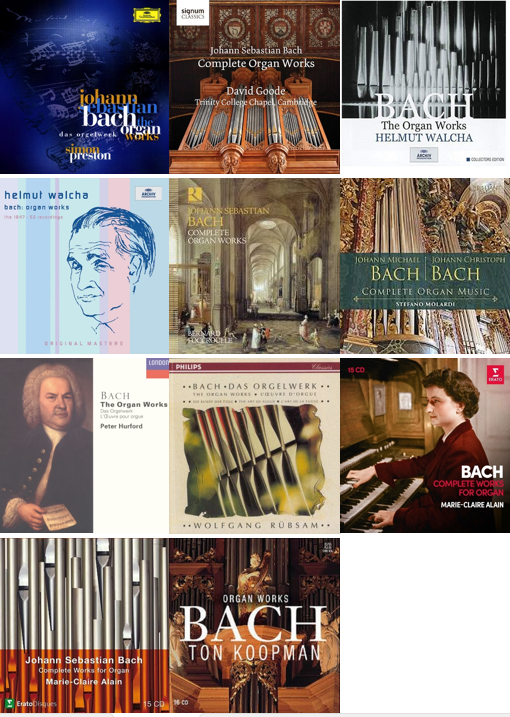
A musical point of interest is the rests interspersed within the theme. Similar rests are effective in the fugue theme of Prelude and Fugue in D major, BWV 532, but this piece is even more so. While one voice plays the theme, the other voices move without interjecting, instead providing accompaniment, maintaining a remarkably clear and open sound. In sections where the lowest note (pedal) plays the theme, the organ’s unique power and stability are added, making the scale of the piece feel even larger. In this piece, Bach elevates the fugue from something “stiff” to something like a “joyful dance”. Now, let’s compare the piece in the following performances.
① Simon Preston (2010, recorded 1980~)
② David Goode (2020)
③ Helmut Walcha (1956 – 1962)
④ Helmut Walcha (1947 – 1952), monaural
⑤ Bernard Foccroulle (1982 – 1997)
⑥ Stefano Molardi (2013)
⑦ Peter Hurford (1974 – 1986)
⑧ Wolfgang Rübsam (1996)
⑨ Marie-Claire Alain (1959 – 1967)
⑩ Marie-Claire Alain (1978 – 1980)
⑪ Ton Koopman (1994 – 1999)
① Preston begins the passage using the high-pitched principal. He then adds multiple reeds to the pedal. This technique is arguably the most popular. The Adagio maintains a melancholic sound using the flute. This is also common to almost all performers. The Fugue is played on the principal, also with the principal pedal.
② Goode’s registration adds a reed to the high-pitched principal. He also adds a reed to the pedal, creating a rich sound. The Adagio is played on the flute. The concluding section ends brilliantly with the organo preno. The fugue, played at a relatively fast tempo, uses the principal with a 16-foot reed layered on top, producing a weighty sound.
③ Walcha plays with both reed and principal. He uses a higher principal with a reed for the pedal, choosing a unique tone. The Adagio is played in the principal register, with Schwebung (whirring, vibrato). The concluding Grave is played quietly, without increasing volume. The Fugue is played in the high-pitched principal register with added reed and pedal, at a moderate tempo. There are also techniques such as changing the tone to flute and reducing volume midway through.
④ Walcha also plays in the high-pitched principal register, but it seems there is no reed in the pedal. The Adagio is played in the flute register, using a relaxed Schwebung. The Fugue seems to be played only in the principal register with the pedal. Again, the performance features variations in registration during the development section.
⑤ Foccroulle begins the Toccata with a sharp, reed-like tone. The Adagio uses a restrained principal register with a flute pedal. In the Fugue, he again uses a dynamic tone with added reed and the principal pedal, but later adds reed as well.
⑥ Molardi. The toccata begins with a high-pitched principal. The pedal that uses multiple lead pipes simultaneously, but it’s an well thought out and also creates an echo effect registration. In the Adagio, he uses a flute pipe melody and with a Schwebung accompaniment in the left hand. In the concluding section, he abandons the Schwebung and uses the soft sound of the flute. The fugue is an orthodox performance with the principal and pedal, with added reeds.
⑦ Hurford also uses a high-pitched principal and the pedal with maltiple reeds. In the Adagio, he uses a principal with Schwebungs and a flute pedal. In the fugue, he aims for a soft performance mainly using woodwind flutes, which sets him apart from the other performers.
⑧ Rübsam performs a clear toccata with the organo preno and pedal, with added reeds. I think this is the most orthodox choice. The Adagio uses reed hand keyboards and flute pedal. The concluding section switches to all-flute pipes, ending the piece with a beautifully mellow tone. The Fugue is performed in a fairly orthodox style, with reeds added to the organo pleno and pedal.
⑨ Alain. A toccata for organo pleno, making good use of the high register. Several reed pipes are added during the pedal solo, resulting in a very brilliant tone. In the Adagio, a quiet reed (crumhorn or oboe) is accompanied by both flute pipe left-hand and pedal, and the concluding section is dramatically changed, ending with the organo pleno. The Fugue seems to be a mix of principal and flute pipes; no reeds are added to the pedal, and it begins and ends with flute pipes.
⑩ In this Alain’s toccata for organo pleno, as expected, the pedal solo gives way to a low reed pipe. The Adagio is played by a flute using the Schwebung technique. The accompaniment is also played by a restrained flute. The concluding section closes quietly. The Fugue is played by a principal with a reed, and is clearly defined. There is no reed in the pedal section, and it is rather restrained.
Now, regarding Koopman’s piece ⑪ , it has considerable power from the very beginning, and he seems to be using all the pedal stops from 4 to 32 feet in the principal. With the help of the church’s reverberation, it is by far the loudest in these comparisons. The Adagio has a melody played by the oboe, with the pedal and the left hand both played by mainly flute pipe. Midway through, the melody is changed to the flute as an echo in several points, and Koopman’s characteristic abundant ornamentation is added. Surprisingly, the concluding section ends with a quiet volume from the flute. The fugue is a pedal that adds a reed to the organo preno. A 32-foot pedal would be almost certainly used.
Regarding the aforementioned “heel-and-toe” technique, the prevailing modern theory is that while it cannot be definitively said that Bach never used his heels, he primarily played using only his toes, or by crossing his feet. #baroque #bach #organ #fugue #片山俊幸 https://excelkobo.net/bachwerke/archive/BWV0564.pdf