Bach: Passacaglia and Fugue in C minor, BWV 582 / Helmut Walcha et al.
One of Bach’s major organ works. An eight-bar theme played with the pedal dominates the entire piece, making it a work that can be described as a “variation”. This form, symbolic of Baroque music, is a type of continuous variation, where a short phrase is repeated many times on the bass part, and the melody is changed over it. Furthermore, Bach follows the passacaglia with a magnificent fugue using this theme. Several other pieces with similar structures already existed at the time, and these will be introduced here. In many cases, the difference from the “passacaglia” is that a specific bass line is predetermined.
<La Folia>
A very famous specific melody and chord progression of Spanish and Portuguese origin, meaning “madness (Folia)”. There is a “fixed form” that has continued since the 16th century, and the standard pattern is a variation that starts quietly and gradually builds to a frenzied climax. Numerous composers have written pieces using this theme. Representative examples include Corelli and Vivaldi’s “La Folia”.
<Romanesca>
A variation form with a specific bassline that was popular in Italy from the 16th to the 17th centuries. Like “La Folia”, it has a fixed chord progression (characterized by a descending line), but it is even more archaic and possesses a simple beauty. Representative examples include lute pieces by Mudara and Piccinini.
https://www.youtube.com/watch?v=a2uRvQv97I8
<Passamezzo>
A dance form that was extremely popular throughout Europe, especially in Italy, from the 16th to the 17th centuries. It is based on a specific bass movement and harmonic progression, and can be broadly divided into two types.
① Passamezzo Antico: Has a calm, minor key sound and is also used as accompaniment for the English folk song “Greensleeves”.
https://www.youtube.com/watch?v=w8rMEy87h7o&t=6s
https://www.youtube.com/watch?v=C91NGYB-WbE
② Passamezzo Moderno: A type with a bright sound in a major key.
https://www.youtube.com/watch?v=45wxGVE0y18&t=11s
https://www.youtube.com/watch?v=S5wXKVeY7htNc
<Bergamasca>
A dance originating from the Bergamo region of Italy, characterized by a very simple yet powerful bass melody. A characteristic feature is the repetition of the fundamental chord progression “Do-Fa-So-Do (I-IV-V-I)”. A representative example is Frescobaldi’s Bergamasca.
https://www.youtube.com/watch?v=-9y8y1T6bLI&t=194s
https://www.youtube.com/watch?v=-l7d7dwKuLY&t=4s
<Ruggiero>
A bass pattern believed to have originated in 16th-century Italy to accompany the melodic phrasing of the epic poem “Orlando Furioso”. Its characteristic feature is the bass repeating a specific melody based on movements such as G-C-D-G, with improvisational variations built upon it. It is frequently found in variations for keyboard instruments by composers such as Frescobaldi.
https://www.youtube.com/watch?v=bccV0dGKy0s
https://www.youtube.com/watch?v=ud-QpPA9lfA&t=78s
<La Monica>
This harmonic progression is based on a popular song of the time with lyrics like “Mother, don’t make me a nun (Madre non mi far monaca)”. Its distinctive feature is that the chord progression, which is paired with the melody of the song, is used as the foundation for variations, rather than the bass melody itself.
https://www.youtube.com/watch?v=_Q7EBmBf7Xs&t=6s
https://www.youtube.com/watch?v=bbiw521SguA
<Descending Tetrachord>
While not specifically named, this form, often called the “lamenting bass”, was frequently used in Baroque music. It repeats four notes, such as “A-G-F-E”, as if descending a staircase. It is often used to express sadness or despair. Representative examples: Purcell’s “Dido’s Lament (When I am laid)” from “Dido and Aeneas”, the canon-style ground from Purcell’s “Diocreesian”, the finale of Biber’s “Rosary Sonata”, Vitali’s “Chaconne”, etc. Many of Lambert’s “Court Songs (Air de Court)” also utilize this bass. These variations of “fixed patterns” were similar to the feeling of “having a jazz session using a set chord progression” for musicians of the time.
https://www.youtube.com/watch?v=Kc4y6VJMFlI&t=3s
https://www.youtube.com/watch?v=is_GKcyX9iQ
https://www.youtube.com/watch?v=mUIDNUipyck&t=14s
https://www.youtube.com/watch?v=8XUS2yG2L5I
https://www.youtube.com/watch?v=4oq1-UWX-_w
The Chaconne is very similar to the Passacaglia, and in modern times, they are often not strictly distinguished, but historically, the Chaconne emphasizes “chord progressions”. It has a relaxed 3/4 rhythm, and a specific chord progression is repeated. Like the Passacaglia, it is not a piece of music with a fixed bass line. Often more elegant and sometimes passionate than a passacaglia, a prime example is Bach’s “Chaconne” for solo violin. Now, let’s get to the main point. As usual, I compared the following CDs.
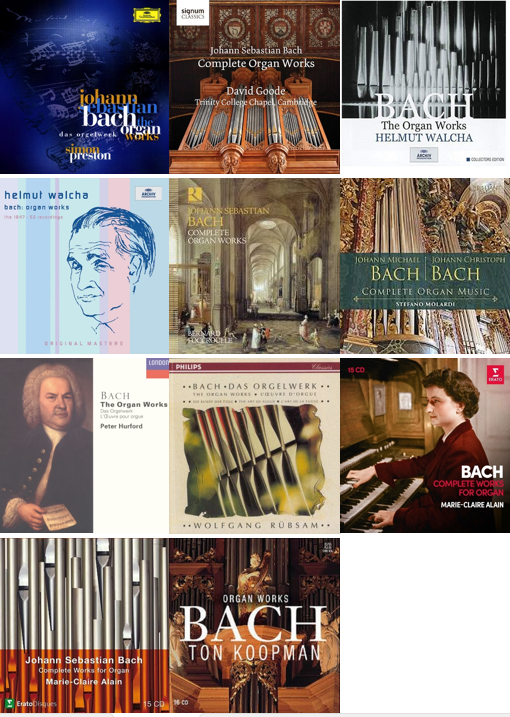
① Simon Preston (2010, recordings from the 1980s)
② David Goode (2020, recordings from 2013-2019?)
③ Helmut Walcha (1956 – 1962)
④ Helmut Walcha (1947 – 1952) Mono
⑤ Bernard Foccroulle (1982 – 1997)
⑥ Stefano Molardi (2013)
⑦ Peter Hurford (1974 – 1986)
⑧ Wolfgang Rübsam (1996, recording year possibly 1993?)
⑨ Marie-Claire Alain (1959 – 1967)
⑩ Marie-Claire Alain (1978 – 1980)
⑪ Ton Koopman (1994 – 1999)
The differences become immediately apparent from the opening pedal playing. Some use a relatively quiet, flute pipe, while others use a more vibrant tone, including that of a reed pipe. The former includes ① Preston, ③ Walcha, ④ Walcha, ⑧ Rübsam, and ⑨ Alain. In contrast, the latter includes ② Goode, ⑤ Foccroulle, ⑥ Molardi, ⑦ Hurford, ⑩ Alain, and ⑪ Ton Koopman. Interestingly, ② Goode, ⑩ Alain, and ⑪ Koopman use very similar registrations.
From measure 89 of the Passacaglia, the theme, previously played by the pedal, is now played by the upper voices. From measure 113, a quiet arpeggio pattern continues (often using two different keyboards to create timbral variations), and at measure 129, the theme returns to the pedal (this section is often played with a lead added to the principal, or with a “Organo Pleno” where large and small principals are layered), leading into the coda.
Then comes the fugue. This is a four-voice double fugue, employing triple counterpoint (in the pedal response section of the theme exposition, the tenor plays a free melody), with the passacaglia theme (first half) and two countermelodies intricately intertwined. The tightly constructed structure from the development section (based on the sixteenth-note countermelody that appears in the tenor at measure 174 of the exposition) to the recapitulation is breathtaking, and the piece concludes with a coda of overwhelming weight and grandeur.
Regarding the section where the upper voices enter after the presentation of the Passacaglia theme and the folowing fugue:
① Preston uses a gentle flute tone and employs a very restrained expression, but as the piece progresses, from measure 83 he adds reeds and principals to build up the intensity, returning to a quiet flute at measure 120, and then returning to organo pleno from measure 129, resulting in a dynamic performance. The fugue in the second half begins with organo pleno played by the principal, producing a clear tone. Reeds are also added to the pedal. The piece concludes with a registration that includes the reeds.
② Goode’s performance of the entire Passacaglia is dominated by organo pleno. He inserts an improvisational phrase just before the coda of the fugue, which is played at a faster tempo.
③ Walcha plays the Passacaglia with the principal pipe tone throughout, gradually increasing the number of stops to build up the intensity of the piece. From measure 48, high-pitched stops are added, and from measure 73, even more stops are added. From measure 105, the stops are slightly reduced, and from measure 114, the flute pipe is used. From measure 129 until the end, it is an organo pleno with the pedal and reed pipe added. The fugue is played by the principal. Almost the same registration is used from the development to the recapitulation, but the pedal is reinforced with the reed pipe towards the end.
④ Walcha. Here, Walcha begins playing the passacaglia with a tone primarily using the flute pipe. As usual, the principal pipe is added from measure 48. From measure 73, the reed pipe is added. After the arpeggio, it continues in organo pleno until the end. The fugue begins in the principal style, switches to the flute pipe from measure 198, and from measure 239, it becomes organo pleno with the pedal and reed pipe added, leading to a magnificent coda.
⑤ Foccroulle begins playing the Passacaglia on an organo pleno over a pedal reinforced with a reed. He appears to play the entire Passacaglia using only this registration. The same applies to the Fugue. I think this is a truly “clean” performance.
⑥ Molardi also uses a principal-style registration on a pedal reinforced with a reed, but it might be somewhat restrained. The Fugue’s registration remains unchanged except for the coda, but perhaps playing the entire piece in such a straightforward manner is also a valid approach. It seems that Bach’s music doesn’t need any “tricks”.
⑦ Hurford plays the Passacaglia using the organo pleno, a common registratuon, over a pedal reinforced with multiple reeds. He also plays the Fugue almost entirely with the same registration.
⑧ Rübsam, in stark contrast, begins playing the Passacaglia with a soft, flute pipe. From measure 73, a reed pipe is added to the pedal, and the music gradually builds up. The piece ends brilliantly with a heavy reed pedal on the organo pleno. The fugue is played in the style of principal with a pedal accompanied by a reed. The tempo of the fugue is quite fast.
⑨ Alain. She begins playing with a flute-type pedal and the manual keyboard of a flute pipe. She then builds up the music by adding the principal. From measure 97, a reed pipe is added to the pedal. From measure 129, it’s the organo pleno. A 16-foot reed is added to the pedal, and the passacaglia ends brilliantly. The fugue is registered with the manual keyboard of the principal and a pedal reinforced with a reed. The coda is the organo pleno.
⑩ Alan uses a reed on the pedal from the beginning on this recording. There are few changes to the registration. From measure 129, he adds a 16-foot reed on the pedal. The fugue also uses basically the same registration.
⑪ Koopman begins the passacaglia with a heavy sound, using a 16-foot pedal and a reed. Considering the characteristics of the built in 1732 by Rudolf Garrels used in the recording, there is a high possibility that a 32-foot pipe was added, and among the recordings compared, the majestic and deep pedaling is outstanding. It is the most powerful pedaling among those compared.
*The “measure numbers” in the fugue above are consecutive from the passacaglia. #baroque #bach #organ #fugue #片山俊幸
https://excelkobo.net/…/Bach_Passacaglia_and_Fugue_in_C…