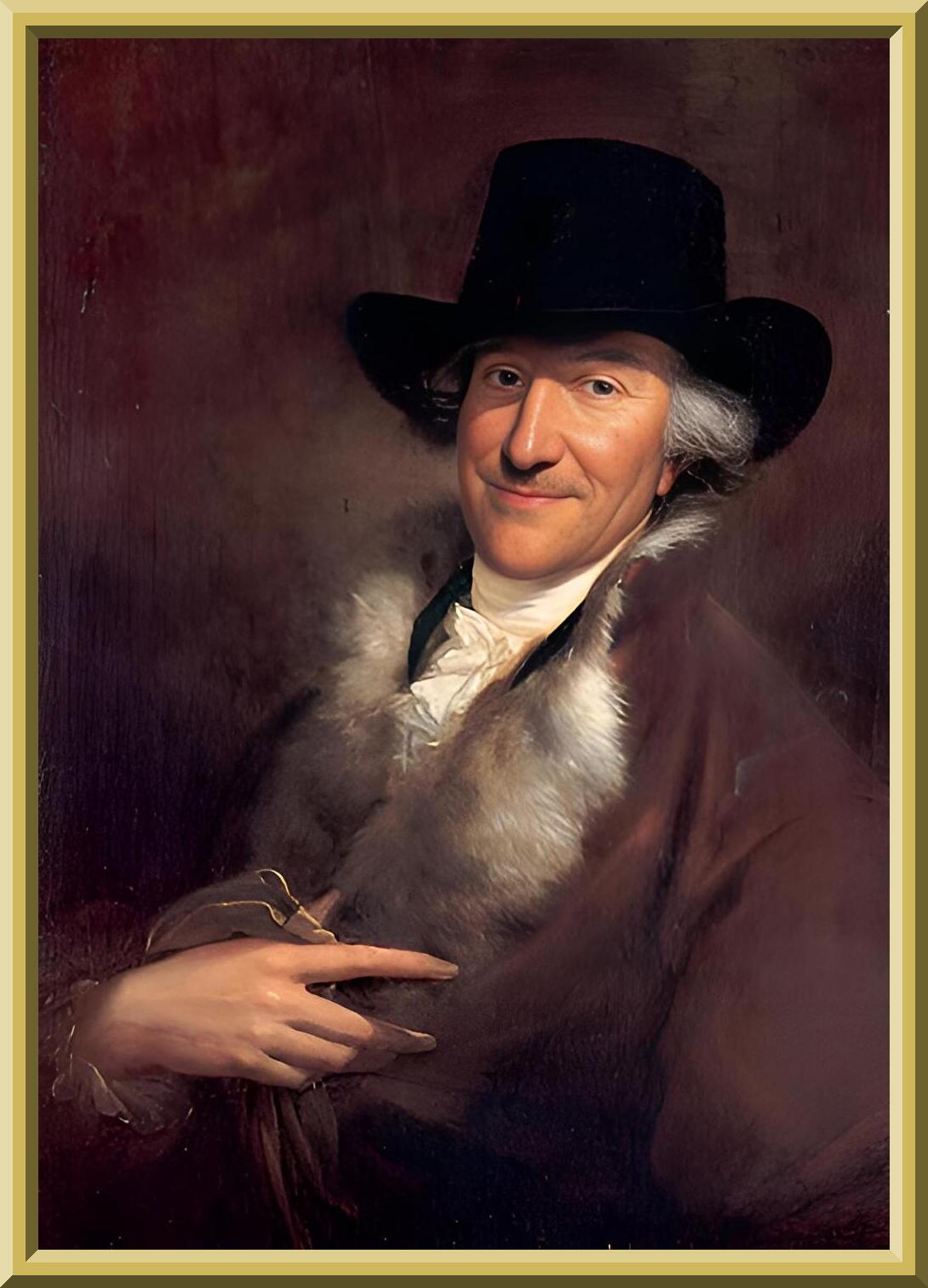
The Sold Score — A Monologue by Wilhelm Friedemann Bach
Berlin, 1784
Outside the window, July rain beats against the cobblestones. I cannot even afford to keep a fire burning in the hearth of this room—let alone a harpsichord; that was pawned away ages ago. Here, on the bed of this cheap lodging, I find myself counting up the seventy-three years of my life.
I have no clear memory of being born in Weimar. By the time I was old enough to understand the world, only the atmosphere of that city remained settled deep in my memory: the sound of court musicians’ footsteps and the lingering echoes of my father’s organ. When I was thirteen, my father was appointed Cantor at St. Thomas Church in Leipzig, and our family moved there. I recall the hard wooden benches of the St. Thomas School, the charts of Latin declensions, and—woven between them—the lessons in counterpoint my father gave me. Back then, I never once doubted what I was destined to become. I was the eldest son, my father’s most promising pupil, and the one who would eventually surpass him—I believed this with absolute certainty.
Looking back now, I realize that studying law at the University of Leipzig was not a way to leave music behind, but rather a detour that ultimately led me back to it.
The Last Project with My Father
What comes to mind is that dimly lit study. Even in his final years, as his eyesight failed, my father kept his pen in hand. I helped him write *The Art of Fugue*—that monumental work, akin to a vast architectural structure—working side-by-side with him in perfect tandem. He would present a theme; I would imitate and develop it; sometimes he would correct my errors, and at other times, he would offer a simple word of approval: “That will do”. I can say now that those moments were the most fulfilling of my entire life.
What I remember most vividly is the night my father arranged *Contrapunctus XIII* for two harpsichords. Facing my father across the two manuals of the keyboard, we played musical lines that mirrored one another. His fingers chased the melody I played, while mine overtook his. In those moments, we were neither teacher and student nor father and son; we became the musical voices themselves.
In 1750, my father passed away.
How am I to speak of what followed? The vast collection of scores he left behind—autograph manuscripts of cantatas, the proofs for *The Art of Fugue*, and that single sheet for two harpsichords that embodied the very memory of that night—I sold them off, page by page, simply to make a living. There are some to whom I sold them whose identities I can no longer clearly recall. Let me confess: I was not the guardian of my father’s legacy, but a peddler selling it off piece by piece. I do not know where those scores are now, into whose hands they have passed, or under whose name they are being performed.
Halle, and Days of Improvisation
When I first took up the post of organist at the Church of Our Lady in Halle, I had yet to doubt myself. Yet, friction with the church authorities deepened with each passing year. They demanded punctuality and adherence to rules; I sought only to remain faithful to the music itself. After eighteen years, I resigned, telling myself I would live as a free musician.
My reputation for improvisation, however, was no lie. Whether in Dresden or Braunschweig, whenever I sat at the keyboard and sought a theme, the audience would hold its breath. The art of the fugue inherited from my father—the skill of layering, chasing, and intertwining musical voices in the heat of improvisation—was something no one could take from me; it was truly my own. A musical architecture that existed only in that moment and that space, never to be committed to a written score—I believed that this was the true path to surpassing my father. The six sonatas for two flutes that I composed in Berlin for the King of Prussia were also highly acclaimed there. They, too, were my own response to the fugue. Regarding that work—the Adagio and Fugue for two flutes and string ensemble—I still feel today that it was not merely a contrast between a slow movement and a fast one. It was my own answering voice to the theme that was my father.
My Younger Brother, Emanuel
I cannot conclude this confession without speaking of Emanuel.
My younger brother was always a steady, reliable man. He secured a position at the Berlin court, married, and built a family; after our father’s death, he even took in and raised Christian, our youngest half-brother. While I was busy selling off musical scores, my brother authored *Essay on the True Art of Playing Keyboard Instruments*, which became a bestseller across Europe. When I read those two volumes, I felt a pang of jealousy—though I was loath to admit it. As a theorist and an educator, he established the name “Bach” on a path distinct from our father’s. I, meanwhile, had merely been peddling that name piece by piece.
Whenever word reached me of my brother’s success in Hamburg, a tumult of complex emotions would stir within me. Succeeding Telemann as music director, releasing his *Keyboard Works for Connoisseurs and Amateurs*, and the honor of eventually being laid to rest in St. Michael’s Church—all of these achievements were the mirror image of what had eluded me. Yet now, lying here on my sickbed, I reflect on this: my brother inherited our father’s “teachings,” while I inherited his “voice”. Which of us was right? No one can say anymore.
Conclusion — In Whose Name Does the Music Resound?
Now, let me record one final thing—something I have never told a soul.
Among the scores I sold off, there were, in fact, a few pieces of my own composition mixed in. There were counterpoint fragments I had added by imitating Father’s handwriting, a short fugue I completed using one of his themes, and—this is just between us—works sold under Father’s name that were, in truth, entirely my own creations from start to finish. It sounds noble to say I did it to make a living. But the real reason was this: I believed that under Father’s name, my music would survive. For a work that might otherwise fade into oblivion under the name of Friedemann Bach would, if attributed to Johann Sebastian Bach, surely continue to be played for generations to come.
It is a curious irony. While I was peddling off my father’s legacy, I was simultaneously selling my very self into that name—into the name of “Father”.
Should scholars of a future age ever encounter a score and tilt their heads in doubt—wondering if it is truly an authentic work by Johann Sebastian—I ask them to remember this: it is but another echo of the musical voices my father and I once wove together on two harpsichords that night. Whether it is my father’s voice or my own—a distinction no one can any longer discern—that sound will go on resonating.
The rain outside the window has not yet ceased. Yet, I am no longer afraid. For even if my own name fades away, that voice—that musical line—will continue to sound somewhere. #baroque #wilhelmfriedemannbach #bach #片山俊幸