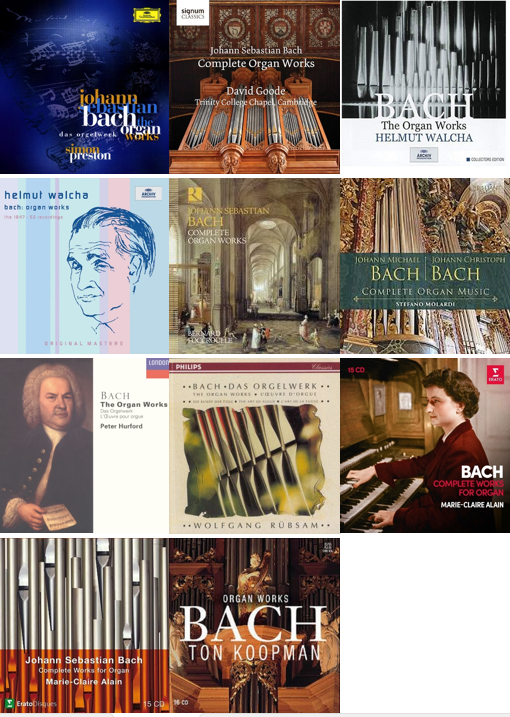

Bach: Prelude and Fugue in C minor, BWV 546 / Helmut Walcha et al.
This prelude and fugue is a rare piece written at a different time in Bach’s life. Research suggests that the fugue was written during his Weimar period, with the prelude added during his Leipzig period. The prelude begins with a solemn introduction played with organ points and chords, followed by a fantastical passage of eighth notes and triplets. The introductory chord pattern reappears a total of three times. Throughout this, the same pattern (C-D-E♭-F-G-F-E♭-D-C) is repeated four times in the bass voice (played by the left hand and pedal), without transposition, always in the same key. This pattern appears twice in the upper voice, but in different keys (G minor and D minor). The melody reappears later in G minor in the tenor, but its movement is unconventional, with the bass taking over partway through. At the three organ points (F, B♭, F), striking passages of sixteenth notes appear, playing an important role in the coda as well.
The following fugue is written in alla breve and, like the “Musical Offering”, is a theme that includes a cadence. It is an extremely striking melodic theme. The bass presents the theme, followed by the tenor’s response, then the alto’s presentation, and finally the soprano’s response. The pedal enters delayed, starting at measure 39. After the pedal’s second presentation, the piece enters a development section using a new motif. Many performers change their registration here. The theme reappears in the tonic and dominant keys, as well as E-flat major and F minor. This fugue is classified as a “free fugue”, which does not require a strict swapping of the upper and lower voices. Free from the constraints of inverted counterpoint, this fugue demands a higher degree of improvisational sensibility and inspiration in its development. Constructed solely through pure musical development, without relying on mathematical “efficiency”, this fugue allows us to feel Bach’s raw creativity more strongly. I believe that such “free fugues” demand more inspiration in composition than strict fugues.
① Simon Preston (2010, recorded 1980~)
② David Goode (2020)
③ Helmut Walcha (1956 – 1962)
④ Helmut Walcha (1947 – 1952), monaural
⑤ Bernard Foccroulle (1982 – 1997)
⑥ Stefano Molardi (2013)
⑦ Peter Hurford (1974 – 1986)
⑧ Wolfgang Rübsam (1996)
⑨ Marie-Claire Alain (1959 – 1967)
⑩ Marie-Claire Alain (1978 – 1980)
⑪ Ton Koopman (1994 – 1999)
② David Goode (2020)
③ Helmut Walcha (1956 – 1962)
④ Helmut Walcha (1947 – 1952), monaural
⑤ Bernard Foccroulle (1982 – 1997)
⑥ Stefano Molardi (2013)
⑦ Peter Hurford (1974 – 1986)
⑧ Wolfgang Rübsam (1996)
⑨ Marie-Claire Alain (1959 – 1967)
⑩ Marie-Claire Alain (1978 – 1980)
⑪ Ton Koopman (1994 – 1999)
① Preston begins the prelude in organo pleno, maintaining the same registration throughout. The pedal is reinforced with reed. The fugue appears to have both large and small principal parts, along with a flute pipe. A reed pipe is added to the pedal, creating a sense of depth.
② Goode also uses organo pleno, but it appears to have a reed pipe added. Again, reed is used to add depth to the pedal. The fugue features both large and small principal parts, with a reed pipe added to the pedal. The development section begins with a soft melody primarily played by the flute, but the registration gradually intensifies. Echo effects are also present.
③ Walcha begins the prelude with a higher principal part in oregano pleno. The tutti is in organo pleno, but after a ritardando, from measure 25 onwards, the tone primarily uses a reed (oboe). The registration then returns to organo pleno in the tutti sections. The fugue begins in organo pleno, but changes to a softer flute tone in the development section, gradually building up with added registration.
④ Walcha’s performance begins in organo pleno, and there doesn’t seem to be much noticeable change in registration until the end. The fugue begins with the principal in the middle register, and as usual, the pedal is reinforced with reed. The registration remains almost the same in the development section, but it seems that reed is added to the tenor voice partway through.
⑤ Foccroulle’s performance begins with the upper voice of the principal, with a pedal reinforced with reeds. The registration remains unchanged throughout. The fugue is also in organo pleno. The pedal is reinforced with reed to create a weighty sound. There is no noticeable change in tone in the development section. The performance is calm and understated overall.
⑥ Molardi. This performer also plays the prelude on an organo pleno, using the usual style of pedal with layered reeds. The fugue is also played on the organo pleno. The fugue, played at a relatively slow tempo, could be described as having a “giant’s pace”. In the development section, the tone is primarily principal with reduced volume, but the registration gradually increases, building to a climax.
⑦ Hurford plays the prelude on an organo pleno, beginning with a relatively clear tone, and there appear to be no significant changes to the registration. His fugue is played with a distinct flute sound, setting it apart from the other performers. No reeds are added to the pedal, and the fugue begins with a quiet atmosphere. The flute-dominant tone continues in the development section, gradually increasing the principal notes to build intensity. Reeds are only added to the pedal towards the end.
⑧ Rübsam plays the prelude on an organo pleno at a fairly fast tempo. The fugue is also played on an organo pleno at a relatively fast tempo. There are few changes to the registration, but towards the end, he seems to add low-pitched reeds to the pedal.
⑨ Alain plays the prelude on an organo pleno. No reeds are added to the pedal at the beginning. The sudden change in registration from measure 70 is somewhat abrupt, raising suspicions of a possible recording “trick” (although there is no concrete evidence). The fugue begins with the principal’s main keyboard part and the flute’s pedal. The tenor part in the development section appears to be a mixture of the oboe and principal. A reed is finally added to the pedal at measure 140.
In ⑩, Alain begins the prelude with an organo pleno reinforced with a reed padal. The fugue begins with the organo pleno. Is the pedal a 16-foot reed? A rather solemn bass tone is heard. The development section uses almost the same stops, leading to the coda.
In ⑪, Koopman uses an organo pleno with a reed pipe added, resulting in a rather heavy sound. Is the pedal a 32-foot reed pipe? A heavy tone is also heard. His power is overwhelming compared to other performers. The fugue, played on a weighty organo preno with a 32-foot pedal, is incredibly powerful.