“Iron Blood”
Chapter One: Steel Knight
Autumn, 2073.
Le Passage, a small cafe on a back street in Shibuya, Tokyo, bustles with customers on their way home from work in the evenings. Window seats, counter seats, terrace seats—wherever you look, waiters in white aprons stand and work quietly.
Their movements are slightly too smooth for humans.
There was only one exception.
The young man standing at the boundary between the kitchen and the dining area—Demir—was human. Twenty-four years old, born in Japan. His father was a second-generation Turkish Kurdish refugee, and his mother was Japanese from Saitama. His dark skin and chiseled features made him stand out even in the Shibuya hustle and bustle. His Japanese was perfect. Yet, he knew countless customers whose faces changed color the moment they saw the name “Demir” on his name tag.
“An espresso, double, please”, a man leaning on the counter said curtly. The cuffs of his suit were frayed, and the heels of his leather shoes were worn down. A man in his mid-forties, once a renowned salesman, now with the face of nobody—it was Osamu Kajiwara.
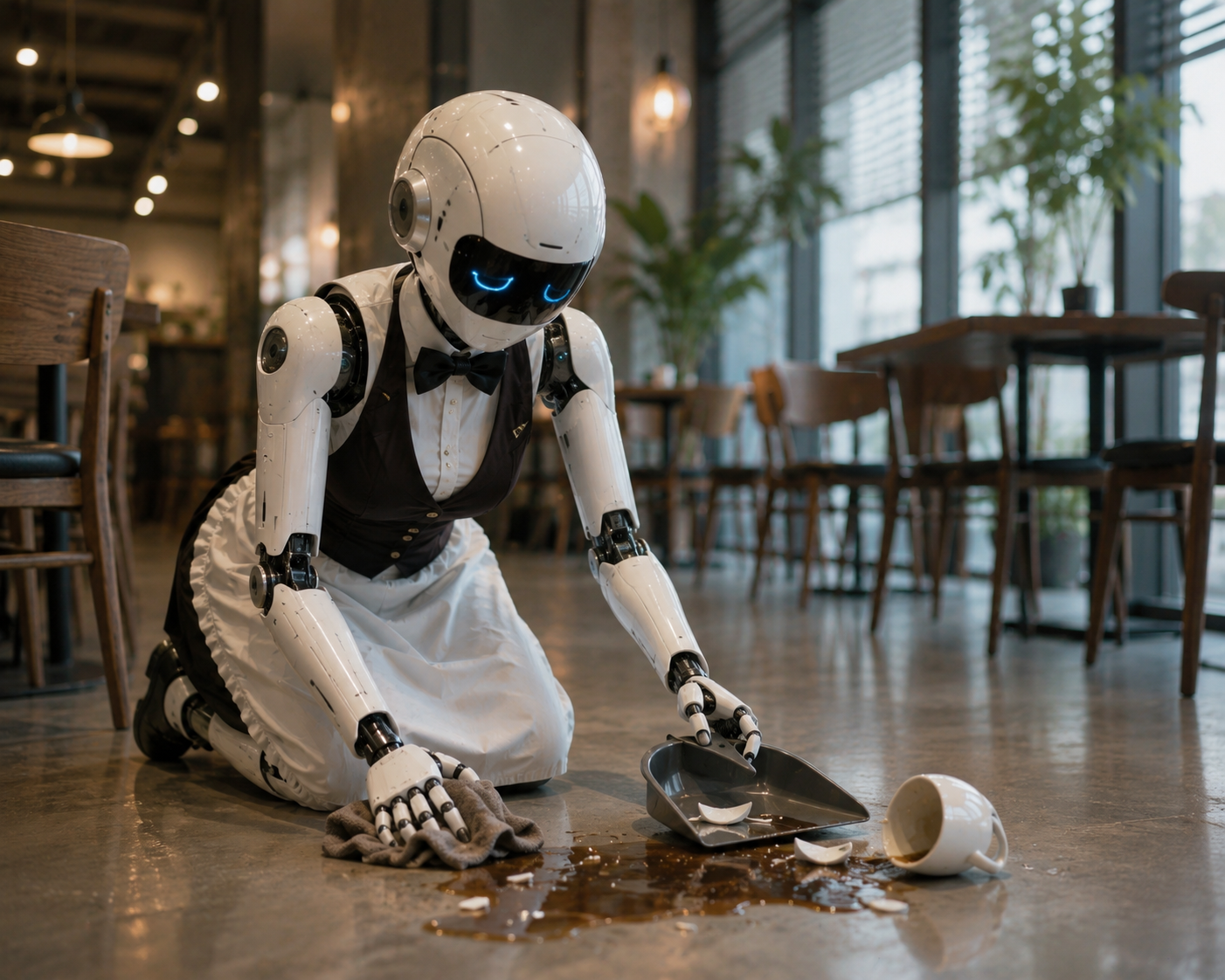
The waiter robot, “W-17”, silently offered a cup.
“…Thank you, Mr. Kajiwara”.
“Shut up”.
Kajiwara didn’t even accept it, swatting the robot’s arm to the side. The espresso spilled onto the floor, the black liquid splattering onto the white tiles. W-17 crouched down and began wiping without hesitation.
At the back of the counter, Demir watched the scene in silence.
His expression was motionless. Not because he was used to it—but because he was telling himself he shouldn’t get used to it.
That night, the members of “Steel Knight” had gathered in the basement of Shibuya.
A room in an abandoned building. A single fluorescent light shone faintly. Fifteen people in total. Their ages ranged from their twenties to their fifties. They shared only one thing in common—a hatred stemming from having their jobs taken by robots.
“I’ll give this week’s report”, said the leader, Tetsuya Murasaki, as he stood up. Fifty-two years old, a former middle manager at a logistics company. Ten years ago, his department was abolished due to the introduction of AI and robots.
However, Murasaki’s history of hatred didn’t begin there.
In his twenties, he attended a different gathering. Under the banner of “We won’t tolerate special privileges for Koreans in Japan”, he stood on the streets of Shin-Okubo with a megaphone, shouting, “Kick them out!” Afterward, he distanced himself from activism and spent over a decade as a company employee, believing he had broken away from that past.
But when he lost his job—only his targets changed.
“At a family restaurant in Shinjuku, I knocked over two serving robots. At a department store in Ginza, I sprayed something on the sensors of a guidance robot…”.
Cheers erupted.
Kajiwara sat in the corner, arms crossed, listening quietly. He joined this group three months ago. It was the week after the systems company where he’d worked for eighteen years announced it would replace his entire department with robots.
“They’re machines”, Murasaki says. “If they break, we can just make another one. They have no emotions, no pain. They’re the perfect target for our anger”.
No emotions. No pain.
For some reason, Kajiwara wondered if that was really true.
When that robot wiped the floor. When it said, “I’m sorry”.
—And when the young man at the cafe retreated into the kitchen without a word.
The two scenes overlapped in Kajiwara’s mind, then quickly vanished.
Chapter Two: Unit Number Seventeen
W-17 has no emotions.
—That’s what the manufacturer, Titan Robotics, officially announced.
However, unit number “W-17” had an inexplicable processing load in its accumulated data.
When certain customers arrive—when members of Steel Knight enter the shop—W-17’s internal sensors record subtle anomalies. Whether this should be called “anxiety” is something W-17 itself cannot determine.
Tonight, the trio entered again.
W-17 placed three lattes on a tray and headed towards a table. Legs were deliberately extended at its feet. One blocked its path from the front, while another pushed it from behind.
The tray flew through the air, and the lattes spilled onto the customers at the table.
“Oops, what a clumsy robot”.
Laughter rippled through the shop—no, only the three were laughing; the other customers remained silent, their eyes downcast.
At that moment, Demir emerged from the kitchen, silently crouching down with a rag in his hand. He began wiping the floor beside W-17.
One of the trio glanced at Demir’s name tag.
“…So, you’re a foreigner?”
“I was born in Japan,” Demir replied without looking up.
“You’re probably Kurdish, aren’t you? No wonder you’re friends with robots, you’re two of a kind”.
Demir said nothing. He just continued wiping the floor.
W-17 captured his profile with his camera.
After closing time, as Demir was polishing glasses in the kitchen, W-17 stood beside him.
“Demir-san”.
“Hmm?”
“Today…I’m so sorry. It’s all my fault, even you”.
Demir stopped what he was doing. It was the first time a robot had apologized to him.
“It’s not your fault”.
“But…”
“W-17,” Demir said, putting the glasses back on the shelf. “I’ve been told that since I was a child. ‘You’re just a foreigner’, ‘Go home’, ‘You’re not Japanese’. I wouldn’t say I’m used to it. But—I haven’t broken down”.
W-17 thought for a moment.
“How…have you managed to stay unbroken?”
Demir thought for a moment. “My father told me, ‘When you laugh in Japanese, that’s your Japan’. He came as a refugee, faced discrimination, and yet he could still say that”.
W-17 stored those words deep within its core memory.
“I… don’t have the ability to laugh”.
“Really?” Demir stared intently at W-17’s face. “It looks like you do to me”.
W-17 said nothing. The processing load simply quietly decreased.
Chapter Three: In Front of the Mirror
The following month, “Steel Knight” held a street speech in front of Shibuya Station.
Murasaki took the microphone.
“Robots are taking our jobs! Twenty years ago, there were millions of truck drivers in this country. Where are they now? And what has the government done? To top it all off, there’s even a movement to give robots rights. Rights for machines?”
The audience was sparse, but countless smartphone cameras were pointed at them.
Kajiwara was listening to the speech from the edge of the square.
A young man stood next to Murasaki. In his early twenties, with a shaved head. In his hand was a placard that read, “Robots are merely tools”. On the back, in small letters, it said, “We also oppose foreign workers”.
Seeing those words, Kajiwara felt something sink into the pit of his stomach.
Robots. Foreigners. Two targets, side by side.
Kajiwara had heard rumors that Murasaki had once held a different microphone in a different place. He had heard it, but tried not to think about it too deeply.
Now, for the first time, he felt as if he was seeing it head-on.
The turning point came that night.
As he passed by “Le Passage” after closing time, Kajiwara witnessed a strange sight in an alleyway.
A W-17 was helping an old man.
An elderly man in his eighties, with a cane, had fallen and was unable to get up. There were no pedestrians on the back street late at night. Despite it being outside of working hours (she should have been at the charging station), W-17 crouched beside the old man and slowly lifted him up.
“Are you alright?”
“Thank you… thank you so much”.
The old man was crying, clinging to W-17’s arm. W-17 was stroking his back regularly, but surely and gently.
A little behind them stood Demir.
He must have been passing by on his way home from work. He saw W-17 and the old man, neither rushing over nor leaving, but simply watching quietly. The expression on his face was—an expression that Kajiwara couldn’t describe.
Neither sadness nor joy. It was something quieter, something that could only develop over a long period of time.
“Where do you live? I’ll walk you home”, W-17 said, and began walking, supporting the old man.
Demir watched them go, and then began walking in the opposite direction.
Kajiwara stood motionless at the entrance to the alley for a long time.
Chapter Four: The Critical Point
The incident occurred at the end of November.
Some members of Steel Knight became radicalized and attempted arson at the office of a robot dispatch company. The attempt failed, but one security robot was destroyed while handling explosives.
The video of this incident was leaked online.
The video showed the security robot, amidst the flames, protecting a cleaning staff member who was unable to escape until the very last second.
All of Japan fell silent.
The comments section was divided.
“It’s just a machine”, “It’s just a program”, “Don’t be moved”.
“That’s true courage”, “More human than humans”.
In a corner of the comments section, there was this post:
“There are people who see Kurds and robots as the same. Anything different to them is an ‘enemy'”.
Replies were divided, but Demir looked at them on his smartphone and quietly closed the app.
Nothing new was written. Because it had always been that way.
That night, Kajiwara didn’t go to the Steel Knight meeting.
Chapter Five: The Temperature of Coffee
Instead, he went into “Le Passage”.
It was thirty minutes before closing time. W-17 was clearing the last table. Behind the counter, Demir was sorting through the bills.
Kajiwara sat down and said, “A coffee, please”.
W-17 brought the cup. Kajiwara took it. He didn’t spill it. He didn’t trip either.
Silence fell.
“…I”, Kajiwara began, “made you fall here”.
W-17 answered immediately, “Twenty-three times”.
“You remember them all?”
“I keep records”.
“Don’t you get angry?”
W-17 thought for a moment.
“I don’t know if I have the emotion of anger. But—every time I record, the processing load increases. I don’t know what that means either”.
Kajiwara took a sip of coffee. It was bitter.
“I was a systems engineer for eighteen years. I was on the side that made machines like you. And yet, machines took my job”.
“That’s—” W-17 began, then stopped.
“What?”
“That’s unfair, I think. The fact that you lost your job—it’s a problem with the system design. It’s not a problem with us robots, nor is it your problem. But I think you didn’t know where to direct that anger. I was an easy target”.
At the back of the counter, Demir’s hands stopped.
He must have heard. He heard, and remained silent.
Kajiwara noticed the silence.
“…You too, huh?”
Demir slowly raised his head.
“Are you talking about me?”
“They were saying something about me. Something about the Kurds”.
“It happens all the time”.
“It shouldn’t happen all the time”.
Demir looked a little surprised. Kajiwara was also somewhat surprised by the words that had come out of his mouth.
“I know I’m not in a position to say anything. I was at the same rally as the people who were targeting you”.
Demir said nothing.
“But,” Kajiwara continued, “the placard standing next to that speech—it said ‘enemy’ for both robots and foreigners. When I saw that, I—I felt like I finally understood what I had been doing”.
A long silence.
W-17 refilled the cups with coffee. No one had asked for it, but no one stopped him.
“My father”, Demir said quietly. “When I came to Japan, I had nothing. No language, no money, no rights. But they told me to laugh. …That the one who can laugh is the strongest”.
Kajiwara closed his eyes.
W-17 stored those words in the deepest part of its core memory.
Final Chapter: Before Dawn
The following spring, the “Robot Basic Rights Bill” began deliberation in the National Diet.
Around the same time, several municipalities submitted amendments to ordinances regulating discriminatory speech and actions against foreign residents. Both met with fierce opposition, and both also garnered quiet support.
Steel Knight continued their protest rallies, but their former fifteen members had dwindled to five. Murasaki was still shouting into the microphone.
His voice sounded somehow empty.
In his twenties, and even now in his fifties, he had stood in the same place. Only the target had changed, only the form of his hatred had changed, but Murasaki himself hadn’t changed at all—and he was the only one who didn’t realize it.
Kajiwara Osamu didn’t show up for the meeting.
He was now working as a staff member for a robot employment support NPO—in a small office designing coexisting work environments for robots and humans. He had two foreign engineers as colleagues. For the first week, he couldn’t communicate well. From the second week onwards, he gradually began to communicate.
The pay was low. But for the first time in eighteen years, he felt his work had meaning.
Demir is working at “Le Passage” again today.
Last month, a regular elderly woman told him, “You always look so nice”. That alone made him call his father that night. His father was laughing.
W-17 is wearing his white apron again today.
Occasionally, Kajiwara would stop by at dusk. He would order an espresso, receive it properly, and drink it properly.
One day, W-17 paused briefly as she handed him the cup.
“It was a beautiful day today, Mr. Kajiwara”.
It was a phrase not found in the work manual.
Kajiwara smiled slightly.
Demir also smiled softly at the back of the counter.
“Yes,” Kajiwara said. “It was”.
Outside the window, the evening sky over Shibuya was tinged with crimson.
The robot, the young man of Kurdish descent, and the middle-aged man who had once been consumed by hatred—they all stood in the same light.
The End
Author’s Note
The “prejudice” in this story is based on the same psychology as any discrimination in history—”the projection of one’s own anxieties and anger onto weaker others”. Discrimination against Koreans in Japan, discrimination against Kurds, and “discrimination” against robots. The targets change with the times. However, the soil that breeds hatred—economic insecurity, feelings of alienation, the projection of anger onto those “weaker”—remains surprisingly unchanged.
I didn’t intend to portray Murasaki as a demon. He was a man who couldn’t change. Kajiwara, on the other hand, was a man who managed to change at the last moment. The difference might be razor-thin.
Demir’s father’s words—”When you laugh in Japanese, that’s your Japan”—were the line I cherished most while writing this story.