
Sequentz in Bach’s Organ Fugues
In Bach’s organ fugues, there are generally two types of sequentz: those that are incorporated into the fugue’s theme itself, and those that are “transitional” passages that respond to the theme’s presentation or lead to a re-presentation of the theme, or where a motif derived from the theme or entirely new is used in the sequentz. Two representative examples of the former are:
1. Prelude (Fantasia) and Fugue in G minor, BWV 542
2. Prelude and Fugue in A minor, BWV 543
In particular, piece 1 is a masterpiece that is arguably the most popular of Bach’s organ works. The prelude typically begins with a powerful tone mainly using the reed pipes, followed by quiet sections using only the flute pipes, and then alternating between these and brilliant sections using the reed pipes—a theory almost universally shared by performers. In the case of Bach’s organ music, there is basically no “composer’s designation of stops”, which is a custom of the French organ school. Therefore, performers often freely mix and match organ stops to complete the piece. Of course, there is no guarantee that the same stops used in one performance will be used on another. Therefore, it is often seen that the same performer uses completely different stops in a different performance (CD).
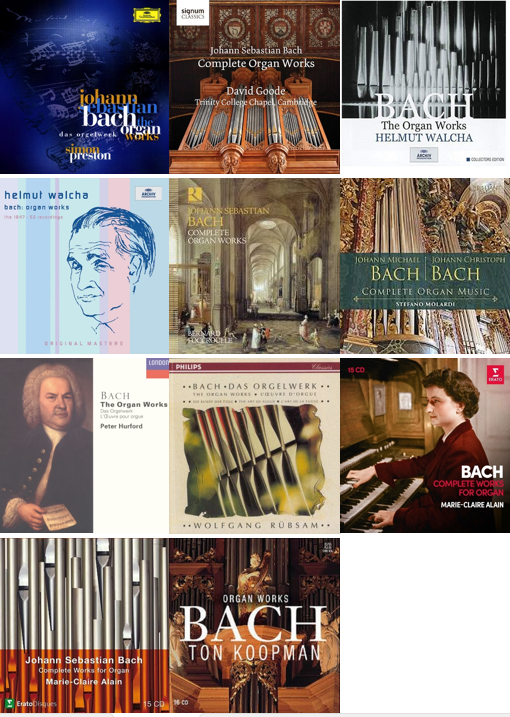
The fugue almost always begins with a tone centered on the principal or powerful reed pipes (organo pleno). This fugue has one of the longest themes in Bach’s works, and the theme itself contains a sequentz. Therefore, it is a fascinating fugue with sequentz scattered throughout the entire piece. The exposition begins with the alto, and the theme is passed on to the soprano, tenor, and bass (pedal). The middle section, also known as the Episode, is a free section inserted between the presentations of the theme. In BWV 542, the “sixteenth-note movement” at the beginning of the theme is used as a motif, and modulations are repeated while making frequent use of sequentz. Stops are switched to the flute, the volume is reduced, and sometimes echo effects are skillfully employed. In the development section, the theme returns in various keys, including the relative key (B-flat major) and the subdominant key (C minor). In particular, each time the theme is presented, the counter-melodies (Counter Subject) are intricately interwoven. Finally, in the concluding section, the theme returns in the original key (G minor), and the piece concludes powerfully with brilliant pedal work from powerful reed instruments (such as trombones). The CDs used for comparison are listed below.
① Simon Preston (2010, recorded 1980~)
② David Goode (2020)
③ Helmut Walcha (1956 – 1962)
④ Helmut Walcha (1947 – 1952), monaural
⑤ Bernard Foccroulle (1982 – 1997)
⑥ Stefano Molardi (2013)
⑦ Peter Hurford (1974 – 1986)
⑧ Wolfgang Rübsam (1996)
⑨ Marie-Claire Alain (1959 – 1967)
⑩ Marie-Claire Alain (1978 – 1980)
⑪ Ton Koopman (1994 – 1999)
② David Goode (2020)
③ Helmut Walcha (1956 – 1962)
④ Helmut Walcha (1947 – 1952), monaural
⑤ Bernard Foccroulle (1982 – 1997)
⑥ Stefano Molardi (2013)
⑦ Peter Hurford (1974 – 1986)
⑧ Wolfgang Rübsam (1996)
⑨ Marie-Claire Alain (1959 – 1967)
⑩ Marie-Claire Alain (1978 – 1980)
⑪ Ton Koopman (1994 – 1999)
The tempo of the fugue is fastest in ① Preston, ② Goode, and ⑧ Rübsam, while other performers generally choose a moderate tempo. ③ Walcha briefly changes the tone to a flute pipe in the middle section, but basically uses a reed pipe throughout the piece. ④ Walcha uses a flute pipe for a longer period in the middle section. Thus, it can be said that performers in this piece are divided into two groups: those who use a flute pipe in the middle section and those who use a reed pipe throughout.
⑥ Molardi also plays with a reed pipe, but what kind of stop is used? It’s a reed pipe with a very different tone from the other performances. If anyone knows what kind of pipe it is, please let me know. ⑦ Hurford also plays the entire piece with a reed pipe (using a bassoon-type stop for the pedal near the coda). ⑧ Rübsam also plays the entire piece with a reed pipe. ⑨ Alain uses a high-pitched principal pipe or reed pipe instead of a flute pipe in the middle section. Alain’s playing in piece ⑩ is also primarily reed-pipe-based. Koopman in piece 11 is similar, but in his case, he consistently makes the pedal volume resonate to the maximum. After listening to all of this, it seems that only Helmut Walcha is creating variations in tone with the flute pipe. #baroque #bach #organ #fugue #片山俊幸