
Jean Rondeau’s Pavane by Louis Couperin
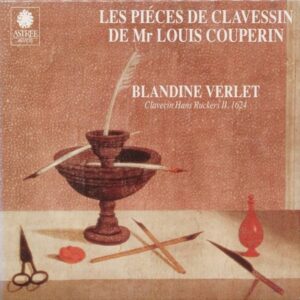
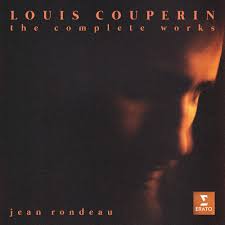
Since the release of Jean Rondeau’s complete collection of works by Louis Couperin, I have listened to it several times; among the tracks, the piece Rondeau focuses on with particular care is the “Pavane (G.120)”. The set includes four versions: two performed on the harpsichord, one on the organ, and one by a viol consort. Of the harpsichord performances, the first uses an original 1624 Ruckers instrument, while the second uses a copy built by David Ley based on a Jacques Thibaut original. Initially, I assumed the organ version was transposed to G minor, but that turns out not to be the case. It appears the organ at Notre-Dame de Juvigny is tuned to A=440Hz—roughly a whole tone higher than the pitch typically used for French harpsichords—meaning Rondeau is actually playing the piece in E minor. This can be confirmed via a YouTube video. The piece’s original key, F-sharp minor, was considered quite daring—and “poor-sounding”—at the time. The Notre-Dame de Juvigny organ seems to be tuned not to meantone, but to one of the “well-tempered” systems used in France during that era. Rondeau appears to have adopted a “well-tempered” tuning for the harpsichord as well, as there are no jarringly dissonant chords. This brings to mind the recording of this piece by Blandine Verlet (Rondeau’s teacher). She seems to have performed it using standard meantone tuning (C-G-D-A-E Aaron’s meantone), resulting in the frequent appearance of the “wolf” interval throughout the piece—though, for my part, I find that performance to have a unique charm of its own. Rondeau, however, was not content to stop there; he also had the piece performed by a viol quartet. Needless to say, this version offers the sound of flawless, pure harmonies. The performance reflects Rondeau’s distinctive approach.
P.S.
So, what kind of tuning did Blandine Verlet use for this piece? From here on, I’ll state that this is all merely speculation. Listening to the score, one thing becomes clear: the D# and E# are high. Anyone listening to the melody line should notice this. Verlet likely didn’t tune the D# from H with no beat, as is typical for sharp-based pieces, but rather tuned it in a different way. I don’t know what that method was. Similarly, for the E#, I suspect it wasn’t tuned with no beat A-C#-E#, but rather tuned it in a different way. Either way, there’s no doubt that the tuning method was such that these two notes were high. One possibility is that she tuned it one quarter comma of fifth below C (a mean-tone fifth). If that’s the case, it would explain, to some extent, the distortion of the melody. #louiscouperin #jeanrondeau #clavecin #organ #viol