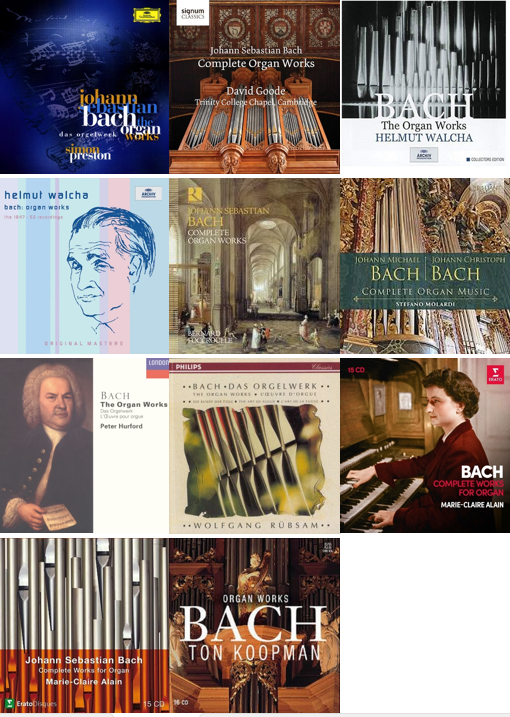

Bach: Prelude and Fugue in E flat major, BWV 552 “Saint Anne” / Helmut Walcha et al.
For a detailed explanation of the piece itself, please refer to the following article:
https://www.facebook.com/permalink.php?story_fbid=pfbid0JXHrppaZh4bx19EPBMEZ1r1P69JiRzQZnXdowZu9XEa4WX39yJh9P9Yk7MnNbjVSl&id=100016209605860
This celebratory music, titled “Saint Anne”, is performed without exception by all performers using the “Organo Pleno” (a combination of multiple principal pipes) or with the addition of reed instruments (oboe or trumpet) to principal. The joyous prelude is a truly refreshing piece, enveloped in a moving atmosphere. After a motif with a long appoggiatura, a joyous sequentz follows. Then, a long section with echoes and imitations continues, before the piece returns to the celebratory motif of the beginning and concludes. As already mentioned, the performer primarily uses principal and reed pipes in both the prelude and fugue. The fugue, in particular, is a magnificent piece with three themes. As usual, I compared the following performances.
① Simon Preston (2010, recorded 1980~)
② David Goode (2020)
③ Helmut Walcha (1956 – 1962)
④ Helmut Walcha (1947 – 1952), monaural
⑤ Bernard Foccroulle (1982 – 1997)
⑥ Stefano Molardi (2013)
⑦ Peter Hurford (1974 – 1986)
⑧ Wolfgang Rübsam (1996)
⑨ Marie-Claire Alain (1959 – 1967)
⑩ Marie-Claire Alain (1978 – 1980)
⑪ Ton Koopman (1994 – 1999)
① Preston and ⑥ Molardi, while lacking in tonal brilliance, produce a calm tone by utilizing a mid-range tone (stop configuration). Of Walcha’s two performances, ③ and ④, the newer ③ (④ is a monaural recording) undoubtedly has an advantage, including in terms of recording technology. Both are Arp Schnitger organs, but the latter seems to be a smaller organ. Alain’s ⑨ and ⑩ are both stereo recordings. ⑨ is said to be a Marcussen organ in Denmark, and ⑩ is said to be mainly a historical organ in France or Switzerland, or an organ based on a historical style. Koopman in ⑪ uses the Anton Bruckner organ at St. Florian monastery in Austria, and fully utilizes the cathedral’s reverberation through his stop technique. In particular, he uses a 32-foot leadpipe an octave lower than usual for the pedals, creating an overwhelming power. ⑦ Harford and ⑨ Alan begin playing the fugue on a flute, which is unusual. If you ask me what my favorite performances are, I think I’d answer something like ② Goode, ③ Walcha, and ⑧ Rübsam. As a bonus, I’d like to mention a performance by Jonathan Scott. Here, a horizontal trumpet (En chamade) is used.
https://bit.ly/4c9bhtm
#baroque #bach #organ #fugue #片山俊幸
https://excelkobo.net/bachwerke/archive/BWV0552.pdf