

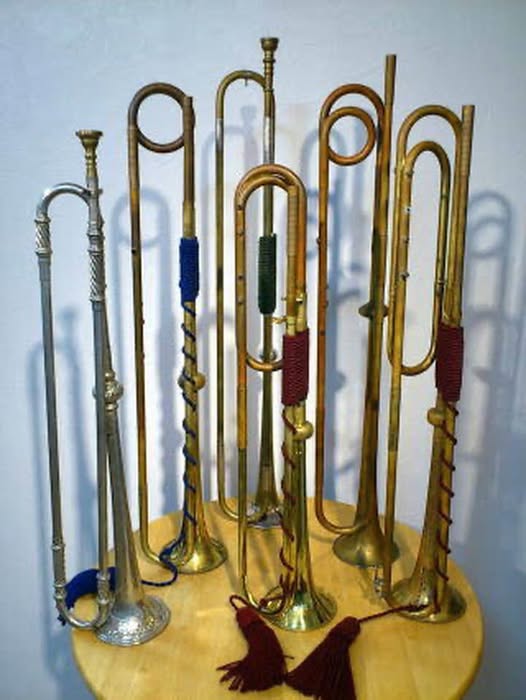
Unacceptable
・Holes in trumpets
This is simply unacceptable. Ideally, the instrument should be played without holes, held high in the air with the right hand while the left hand rests on the hip. Very few performers today still adhere to this playing style.
・Steel strings on violins
This is out of the question.
Acceptable
・Motorized organ bellows
This is a modification that can be considered unavoidable. It would be nonsensical to hire two bellows-pumpers at this stage.
・Double holes on recorders
Given the need for a low F♯, this is likely unavoidable.
・Nylon strings on lutes

A Follow-up to “Acceptable and Unacceptable Modifications to Early Instruments”
https://www.facebook.com/share/p/1EqnHERbu9/?mibextid=wwXIfr
My recent post, “Acceptable and Unacceptable Modifications to Early Instruments”, drew a great deal of attention and a wide variety of comments from many of you. I would like to begin by expressing my gratitude for this. Through the discussion, I realized that there was one point—specifically regarding double holes on recorders—on which I had to reconsider my position. Consequently, I would like to make the following revisions:
Unacceptable
・Holes in trumpets
・Steel strings on violins
・Double holes on recorders
Acceptable
・Motorized organ bellows
・Nylon strings on lutes
There is a famous remark by Mattheson: “Suppose a lutenist lives to be 80, he will have spent 60 of those years tuning his instrument”. If one were truly to spend three-quarters of one’s life tuning, when would there be time to sleep? And, for that matter, when would there be time to practice? While this is clearly an exaggerated, humorous observation, it remains true that, for the player, nylon strings on a lute are a genuine relief.
But let us return to the main topic. Ultimately, does this issue not boil down to where one draws the line between the ideal and the practical compromise?
Consider Gustav Leonhardt: while he lived surrounded by 18th-century furniture, he also made use of electricity and drove an Alfa Romeo. He did not lead a strictly ascetic, Amish-like existence.
In the same vein, I believe that whether or not we, as modern musicians, use digital sheet music or digital tuners is a matter separate from the pursuit of an “ideal”. In fact, by utilizing the conveniences of modern civilization, we gain more time for practice and research—and is that not a good thing? It seems to me that as long as the instrument itself is approached with an authentic, uncompromising spirit, that is sufficient. Yet, if we pursue this line of reasoning to its conclusion, there remains a fundamental issue that persists. This concerns the subject of boy sopranos and boy altos. Discussions on this topic tend to become quite heated, so I would prefer to avoid it here. For those who are interested, however, I have explored the matter in greater detail at the following link:
https://excelkobo.net/archive/10603