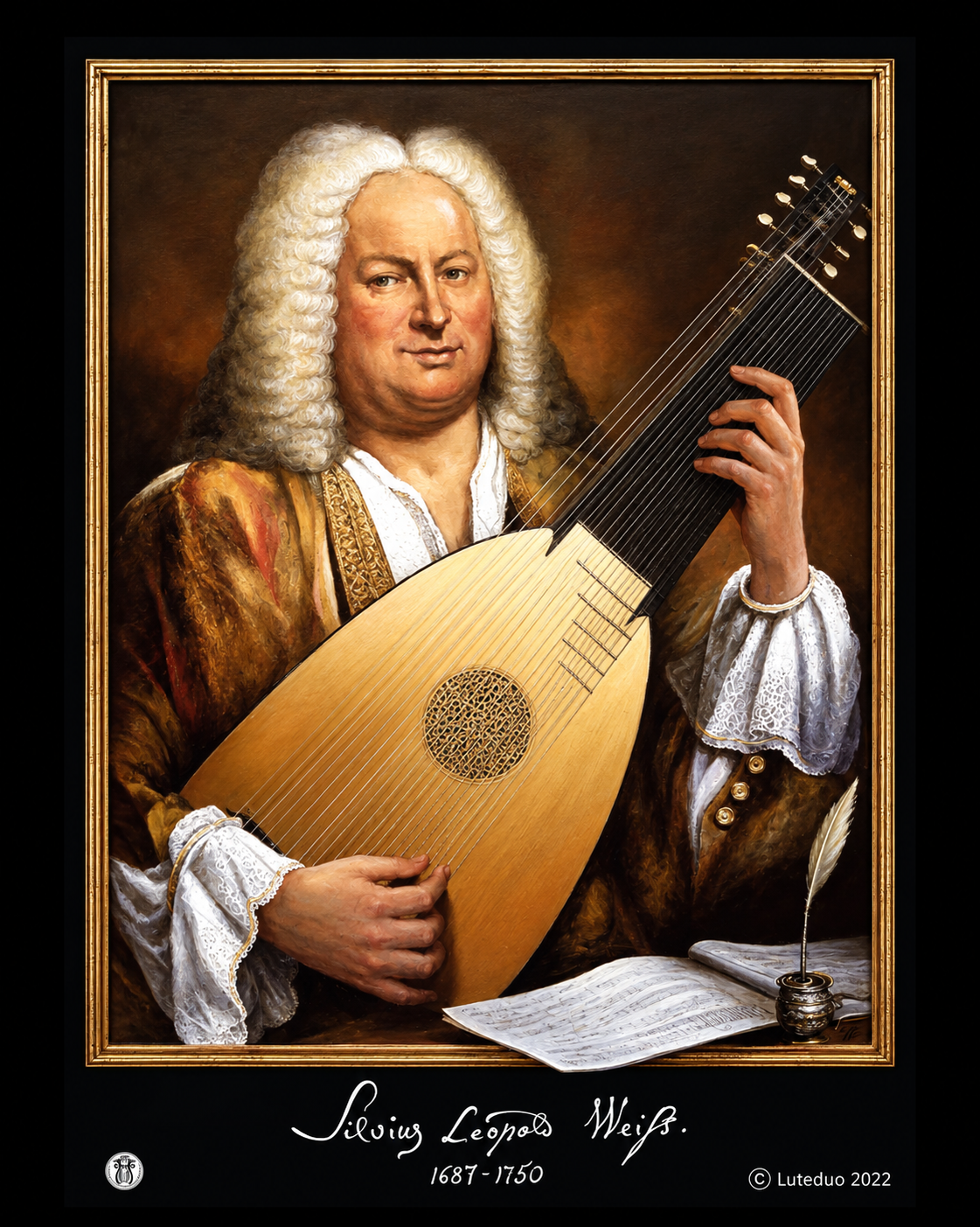

Bach and Weiss
In a past post of mine titled “Bach’s Tuning Method”, I put forward the following hypothesis:
https://www.facebook.com/permalink.php?story_fbid=pfbid0DzCPFvQYBERhLj8XPEH4N9x1GKgW8wBEWipmAWmg32VFtiK3tHHFjna9xAqtEbWml&id=100016209605860
Modern physics explains that if one tunes all the perfect fifths in the circle of fifths to be approximately two cents (one-twelfth of a Pythagorean comma) narrower than Pythagorean fifths, the result is automatically equal temperament. However, the unit known as the “cent” cannot be measured without mechanical aids. Assuming Bach was familiar with equal temperament, how did he actually achieve it? Needless to say, tuning methods in Bach’s era relied entirely on the ear; the only available means was to distinguish the number of “beats”. Another possibility—albeit a less likely one—is that he might have used a lute to tune his keyboard instruments, given that the lute is unequivocally an instrument of equal temperament.
While it is highly doubtful whether the great Bach actually tuned his keyboard instruments to “equal temperament”, there is no question that he actually “heard” it. This is because, in the summer of 1739, his son Wilhelm Friedemann returned home from Dresden—where he was serving as an organist—bringing with him the renowned Sylvius Leopold Weiss. At this time, Weiss was staying at the Bach residence in Leipzig for a full four weeks. What did they discuss, and what music did they play together? Might Bach’s substantial body of lute works—though some are believed to have been composed for the “Lautenwerck (lute-harpsichord)” of his own invention—have originated from such interactions? It is said that Bach and Weiss would propose themes to one another and improvise fugues. Naturally, the topic of tuning their respective instruments would likely have come up as well. #baroque #bach #weiss #temperament #片山俊幸