
Index
- The Road to equal temperament
- About “Tartini tone”
- The Alchemy of the Pure Triad: Tuning the Shivers by Ear
- The Cage and the Breath: Rediscovering Aron’s Meantone and the Myth of the Fixed Grid
- Thoughts on Aron’s Meantone Temperament
- The Logic of Well-Temperament: Werckmeister III vs. Kirnberger III
- The Elegance of Vallotti and the “Beautiful Hesitation” of Western Music
- The Enigma of Bach’s Tuning: Deciphering the Curls and the Whispers of the Ears
- The Bach Tuning Enigma Part II: A Counterargument to Bradley Lehman’s Hypothesis
- The Complete Works of Louis Couperin / Jean Rondeau
- Jean Rondeau’s Pavane by Louis Couperin
- The Collapse of the Lehman Hypothesis: Wishful Thinking vs. 18th-Century Common Sense
- About boy soprano
- The Raving Frenzy of the Lehman Cultists and the Polyclerical Inquisitors
The Road to equal temperament
The Road to equal temperament
What was the meaning of “Wohltemperierte” in Bach’s so-called “Wohltemperierte Klavier”? Did Bach’s title, “Wohltemperierte Klavier”, really mean “equal temperament”? No, it did not. It probably meant a clavier that could be played to a moderately distant key, or that could be tuned to a remote key with only minor adjustments.
Instruments that need to be tuned every time they are played are stringed instruments such as violins, harps, and guitars, as well as keyboard instruments with strings. Wind instruments cannot be tuned. Rather, wind instruments are “already tuned” when they are made, and are rarely re-tuned by the performer. Of course, this is not the case when the performer is also the maker. Therefore, from now on, when you hear the word “tuning” unless you dare to say otherwise, please think of it as that of “keyboard instruments” or “string instruments.
As a side note, it is desirable for wind instruments to be tuned to “average tuning” as much as possible. This is because it is possible to create “genuine” harmony only when the instruments are in average tuning. However, this is not the case with the ancient instruments of the Baroque era. For example, in the flute, the f is high and does not sound good. On the other hand, the F# is low and sounds good. Therefore, the shape of the lips and the angle of the instrument had to be adjusted when playing.
Tonal music, or music with harmony, appeared in Europe during the Renaissance. Until then, which is mainly based on fourth and fifth degree parallels, genuine harmony would have been used. Later, in the Renaissance, the “third degree” appeared in harmony, and the music gradually began to have tonality (major and minor).
This is where the tricky issue of “tuning” comes in.
There is a term called “pure temperament”. In fact, this is a theoretical tuning, which is impossible in reality. In this tuning, the Pythagorean fifth degree and the major third of the meantone, which will be discussed later, are combined to produce three chords with no roar. However, this genuine harmony is absolutely impossible to use on a keyboard instrument. This is because it is a tuning that cannot go outside of a few chords in C major. As long as the pitches are fixed, it is a tuning method that cannot be realized. At the end of the 19th century, someone thought of a “split-key” organ to realize this tuning, but it was never practical.
So it is not as if genuine (tuning) is absolutely impossible. Of course, it is impossible with keyboard instruments. In fact, it is only possible for vocal ensembles, string ensembles, and wind ensembles. In these ensembles, it is possible for advanced players to instantly and “genuinely” match the so-called “keystone” triads of the melody, although it cannot be explained logically. However, the prerequisite for this is that each part knows perfectly the “sound” and “habits” of its own instrument. There is nothing more beautiful than a genuine harmony created in this way. I don’t have time to go into detail here, but it is surprisingly easy to obtain genuine chords through a physical phenomenon called “Tartini’s tones”.
https://www.facebook.com/groups/593250111017228/posts/1988751838133708/
The meantone tuning method was used from the early Baroque to the middle Baroque and partly to the beginning of the late Baroque. In terms of composers, Frescobaldi, Sweelinck, Louis Couperin, D’Anglebert, and Chambonniere were among those who used it. Sharps and flats were not used much in the music of those days. In addition, there were not many modulations to remote tones. This trend continued until Francois Couperin. There is no doubt that the most beautiful sounding tuning of these composers’ music is the meantone. However, when Rameau came along, there were pieces that meantone could not compete with . Then came Bach’s “Wohltemperierte Klavier” out at last.
It is often said that the recorders of the Baroque era were tuned in meantone, but this is a lie. To begin with, meantones are a tuning method unique to keyboard instruments, and they “always need to be changed”. In other words, in practice, the major third was raised or lowered here and there as needed according to the key of the piece being played.
In the meantone tuning, the four fifths(C-G,G-D,D-A,A-E) are narrowed so that starting from C major’s Do, the note of Mi is genuine to Do. Next, major thirds above and below “So, Re, La, and Mi” are adjusted to be genuine (with no beat) too. The “So #” is taken from the Mi note, but in the case of flat tunes, it is taken from the Do note downward to the genuine. In other words, it is not a “So♯” but a “La♭”. A keyboard instrument tuned in this way, with a meantone, can sometimes sound strange.
For example, in the case of a C major minuet, the second minuet is in C minor. The first minuet is dominated by a genuine sound, but the second minuet is dominated by a dirty major third. The reason for this is that “Re♯” and “Mi♭”, “So♯” and “La♭”, etc. become different names. Also, at some point, you may hear the ultimate bad pitch in the meantone, the Wolf’s fifth degree. This is a “wrinkled” wide fifth caused by the narrowing of the fifth degree, and is an extremely unpleasant pitch.
It is the melody, rather than the chords, that gives us a real sense of the characteristics of a keyboard instrument tempered in meantone. The reason for this is that the semitones are wider in a meantone. When a trill is added to these wide semitones, it gives me an old-fashioned and elegant feeling.
In order to escape the contradictions and restrictions of the meantones, various tuning methods were developed in those days. I’ll leave the details for another time, but such tuning methods are known as Werckmeister’s tuning method and Kirnberger’s third tuning method in Germany, Young’s tuning method in England, Rameau’s tuning method and Rousseau’s tuning method in France. The idea behind all of these methods was to “dilute” the “murkiness” so to speak, by distributing the Wolf’s fifth of the meantone appropriately so that all tones would sound “moderately beautiful” and all tones would sound “moderately dirty. This idea led to the modern “equal temperament”. It is highly probable that the tuning method used by Bach was one of these. Or perhaps Bach’s own tuning method existed. However, since Bach left no written record of his own tuning method, it is an eternal mystery as to what kind of tuning method he referred to as “Wohltemperierte Klavier” (well-tempered clavier).
I once wrote an entry about a film about Bach’s life. In it, a French musician, Louis Marchand, heard the sound of Bach tuning his harpsichord and said, “What is this tuning? I don’t want to fight with a musician who uses this kind of tuning method.” he said, and left the scheduled “harpsichord performance showdown. This is followed by the scene of Bach playing “Fantasy in C minor” by himself after Marchand had fled.
———–
Marchand: “(Listening to Bach tuning) …How on earth is he tuning that harpsichord? That isn’t just some ‘theoretical game’ (*theoretische Spielerei*) like you described, Lebell!” “He’s moving from D major to C-sharp minor, then to A-sharp minor—or is it A-flat major? What kind of circuitous route is he taking?”
Lebell: “……No, he isn’t taking a detour. He is modulating directly. Using a diatonic chord progression built on a series of minor thirds… something that ought to be impossible—due to the ‘wolf’ interval…”
Marchand: “(Regarding the ‘wolf’ fifth) He hasn’t fallen into the trap! That is the very mystery (*Rätsel*) of it! Not Corelli, not Vivaldi, not even that reckless young Rameau ever wrote a single note involving a B chord in F-sharp major! Why? Because Bach knows—he has mastered the entire circle of fifths (*er beherrscht ihn*)!” “You want me to fight a man who creates a whole new musical universe (*ein neues musikalisches Universum*) out of a backwater town with barely five hundred houses—a place like Weimar—and then strolls through it as if it were nothing? Nobody told me about this; absolutely not (*nein nein nein*)!”
I don’t know much about the tuning of the lute instrument. However, most of the frets of the stringed instruments of the time were made of gut. This means that the frets are “movable”. In fact, the lute players I knew used to move these frets every time they tuned, sometimes shifting them diagonally (though I had no idea what that meant).However, this instrument is also capable (in principle) of equal temperament if it wanted to. However, that doesn’t mean that the lute player was always aware of equal temperament.
P.S. In recent years, several people have done some interesting research on the possibility that the figure Bach draws above the title of manuscript score of the first volume of “Wohltemperierte Klavier” may be a clue to “Bach’s Tuning Method”. This is a fairly plausible claim and is worth a look. #baroque #temperament #meantone #bach #片山俊幸
——————————————————————————–
About “Tartini tone”
About “Tartini tone”
The other day I have written about “Tartini Tone” in my article “The Road to Equal Temperament”.
https://www.facebook.com/permalink.php?story_fbid=956577131559265&id=100016209605860
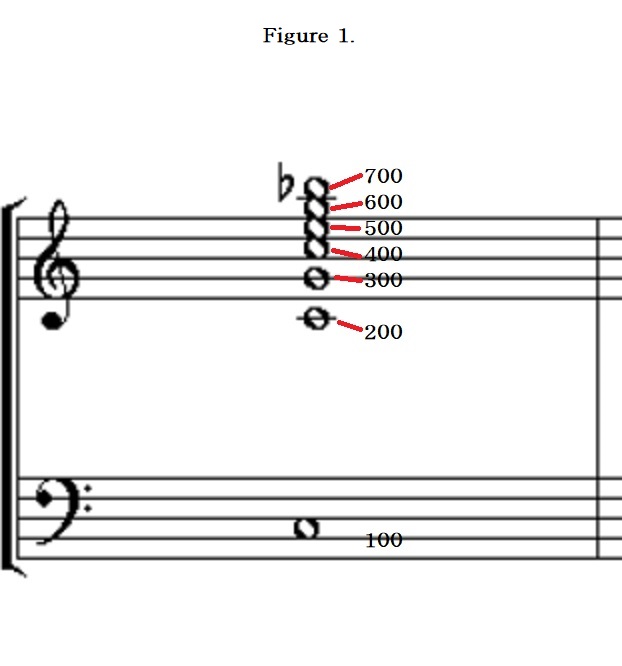
A difference tone (Tartini tone) is a tone with a frequency equal to the difference between the frequencies of the two tones that is heard when two different tones are played simultaneously. For example, a sound of 100 Hz and 101 Hz at the same time produces one beat per second, while a sound of 100 Hz and 104 Hz produces four beats per second. A difference as small as this is perceived by the human ear as a beat, not a sound. However, when the difference in frequency becomes large to some extent, the beats becomes perceived as a tone with the unique pitch. To explain this in musical notes, it looks like this (Figure 1)
For the sake of clarity, let’s assume that the note at 100 Hz is the Do of the F clef. Then the Do one octave higher is 200Hz. Sol above it is 300Hz, and the Do above it is 400Hz, the Mi above it is 500Hz, the Sol above it is 600Hz, and the Si♭ above it is 700Hz. You can see that the difference in frequency between the two adjacent notes is all 100Hz. This means that if you play those two adjacent notes at the same time, you will hear the sound of the F clef Do (100Hz). This is actually audible, so you can try it on a violin or recorder or the others.
The chord obtained at this frequency ratio is a genuine chord. A genuine chord is a chord made of the Pythagorean fifth degree and of the major third meantone degree. The major third of the meantone is about 13.5 cents narrower than the major third of the equal temperament (in essence, the modern piano tuning system). The perfect fifth degree of the meantone is about 3.5 cents narrower than the perfect fifth degree of the equal temperament. In other words, the major third in Meantone is a genuine pitch with no beat, while the fifth degree in Meantone is a fifth degree with even more beat than the equal temperament. This means that in the Baroque era, the beauty of the major third took precedence over the beauty of the perfect fifth.
P.S.;
Tartini, the man who gave the name to this physical phenomenon, discovered that a third low-pitched sound, as if a cello had been added, was being played while he was experimenting with double notes on a violin. Charles Burney, a British composer and historian, mentions the Tartini tone in the chapter about his visit to “Munich and Nymphenburg” in his travelogue. #baroque #tartini #片山俊幸
——————————————————————————–
The Alchemy of the Pure Triad: Tuning the Shivers by Ear
The Alchemy of the Pure Triad: Tuning the Shivers by Ear
In my previous essay on the “Tartini Tone,” I explained how physics hidden within harmony triggers a ghostly lower bass note when a triad locks into absolute purity. But how do musicians actually achieve this organic miracle in real time without modern electronic tuners?
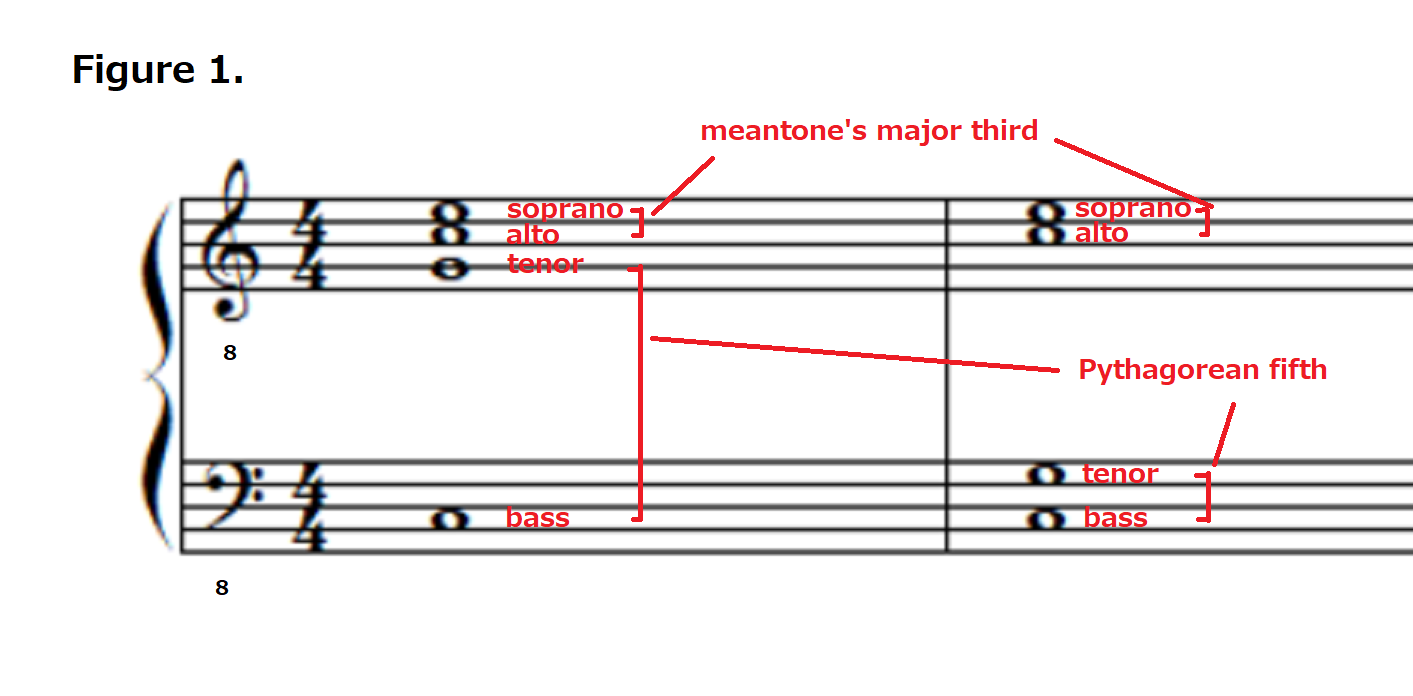
Let us step away from paper diagrams and enter a resonant concert hall for a practical experiment using a recorder consort (Soprano, Alto, Tenor, and Bass). The recorder, possessing very few high overtones, is the perfect acoustic laboratory for this; its pure tone makes Tartini tones remarkably audible and highly responsive to micro-adjustments.
Here is the precise, step-by-step ritual to summon a flawless C major triad:
1.The Core Anchor: The Alto recorder begins by blowing a long, steady C.
2.Summoning the Ghost: The Soprano recorder joins in, blowing an E. Instantly, a third, lower sound manifests in the air—the Tartini difference tone. It will sound exactly two octaves below the Alto’s C.
3.The Micro-Adjustment: Under normal modern equal-tempered breath pressure, this ghostly lower C will sound slightly sharp. To pull this ghost note down into a perfect octave alignment with the Alto’s pitch, the Soprano player must intentionally shade the tone—either by softening their breath or shading a finger-hole to lower the E. The moment the ghost note locks into focus with zero friction, you have achieved a pure, beating-free Meantone major third.
4.Locking the Bass: The Bass recorder now enters, matching its pitch directly to that physical ghost C already floating in the room.
5.Framing the Architecture: Finally, the Tenor recorder introduces the G. This G is a pure Pythagorean fifth, which sits 2 cents higher than a modern equal-tempered fifth. The Tenor player might push their breath slightly or use an alternative fingering to lift it.The result? A crystalline, earth-shaking triad where every single internal difference tone between the four voices converges perfectly onto the Bass recorder’s low C.
The Crucial Insight: The Tyranny of the Third
The ultimate takeaway from this practical experiment is simple: the purity of a harmony lives and dies by the major third.
When an ensemble sounds “dirty” or out of tune, the culprit is almost never the fifth; it is nearly always the major third. A pure, natural major third is astonishingly narrow—a full 13.5 cents lower than the harsh, wide major third found on a modern equal-tempered piano. It requires an intentional, highly conscious effort by the performer to drag that note down.
Meanwhile, the Pythagorean fifth’s 2-cent deviation from equal temperament is so minuscule that it easily falls within the acceptable margin of human error.
This is why academic theorists who spend decades obsessing over a 2-cent adjustment to a perfect fifth (such as Bradley Lehman’s -1/12 comma theories) completely miss the forest for the trees. The Baroque masters did not care about neat, symmetrical formulas on paper. They cared about the physical, visceral thrill of the triad. They knew that pulling a major third down by 13.5 cents was the only way to make the air itself vibrate with the voice of the Tartini ghost—a living, breathing harmony that can only be found when you shut your eyes, put away the diagrams, and trust the ears. #JustIntonation #TartiniTone #RecorderConsort #AronMeantone #EarlyMusic #Acoustics #片山俊幸
——————————————————————————–
The Cage and the Breath: Rediscovering Aron’s Meantone and the Myth of the Fixed Grid
The Cage and the Breath: Rediscovering Aron’s Meantone and the Myth of the Fixed Grid
To truly understand why the Baroque era eventually exploded into the world of Well-Temperament, we must first look straight into the beautiful, dangerous cage of Aron’s 1/4-Comma Meantone.
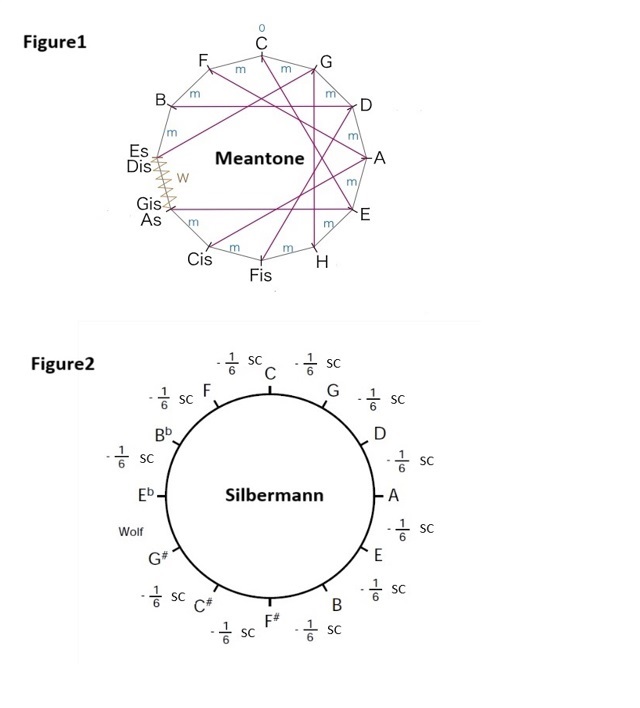
On paper, Aron’s system is a monument to a single, uncompromising desire: a perfect, beating-free pure major third. But the laws of acoustics demand a brutal tax for this purity. To close the circle of 12 fifths (totaling 8,400 cents), a massive mathematical tug-of-war occurs between the Pythagorean comma, the syntonic comma, and the schisma:
・Pythagorean Fifth: ~701.96 cents
・Meantone Fifth (1/4 comma): ~696.50 cents
・Equal Temperament Fifth: 700.00 cents
・The Discrepancy: (700 × 12 = 8,400) vs. (701.96 × 12 = 8,423.52) → The Pythagorean Comma of 23.52 cents.
・The Compression: (701.96 × 4 = 2,807.84) vs. (696.50 × 4 = 2,786.00) → The Syntonic Comma of 21.84 cents.
・The Leftover: 23.52 – 21.84 = 1.68 cents (The Schisma).
The Living Breath of the Performance
Because of this aggressive compression, Aron’s meantone famously limits the playable keys. If you stack eleven of these narrowed 696.50-cent fifths, the final remaining interval—the notorious Wolf Fifth (G♯–E♭)—balloons to a staggering 738.50 cents. It is a terrifying 37 cents wider than a pure Pythagorean fifth. It doesn’t purr; it tears the room apart.
・The Meantone Circle: (696.50 × 11) + 738.50 (Wolf) = 7,661.50 + 738.50 = 8,400 cents
Modern keyboardists often view this as a fatal, static defect. But as a harpsichordist who touches the strings, I contend that Aron’s meantone was never meant to be a rigid, unyielding cage. It was a system of constant, hot-blooded adaptation.
While text-bound theorists assume an entire program was played on a single tuning, the reality under the fingers was far more fluid. Depending on the emotional demands of the repertoire, a builder or performer could effortlessly shift the foundational spine of four fifths—moving it from (C-G-D-A-E) to a sharp-centric (D-A-E-B-F♯) or a flat-heavy (E♭-B♭-F-C-G) to conquer distant keys.
More practically, there is no doubt that musicians utilized the intermission as a theatrical pit-stop. With a quick turn of the tuning hammer during a concert break, a performer could instantly flip G♯ into A♭ or D♯ into E♭, custom-tailoring the instrument’s black keys for the second half of the program. And if a piece demanded both? The craftsman simply weighed the frequencies of their appearance and chose which note to favor, letting the other weep.
Silbermann’s 1/6-Comma: The Elegant Dilution
As the 17th century progressed, the raw, visceral extremes of Aron’s tuning became too volatile for evolving tastes. Enter Gottfried Silbermann and his 1/6-Comma Meantone.
Silbermann’s approach was an elegant act of diplomatic de-escalation. Instead of flattening the fifths brutally by a 1/4 comma, he narrowed all eleven fifths by a gentler 1/6 of the syntonic comma (~3.64 cents), dumping the remaining arithmetic error into the final Wolf (G♯–E♭).
・The Silbermann Calculation: (701.96 – 3.64) × 11 = 698.32 × 11 = 7,681.52 cents.
・The Tamed Wolf: 8,400 – 7,681.52 = 718.48 cents.
By shrinking the Wolf from Aron’s monstrous 738.50 cents down to a far more civilized 718.48 cents, Silbermann achieved a dramatic acoustic rescue. The harmony was instantly smoothed out, the tension relieved.
Yet, every compromise demands a sacrifice. In taming the savage roar of Aron’s wolf, Silbermann also slightly diluted that breathtaking, pure-gold stillness of the 1/4-comma major thirds and the intoxicating, expansive width of the original semitones.
It was the first step on Europe’s long journey toward the gray compromise of equal temperament—a historical reminder that before music became uniform, it was alive, adaptable, and wonderfully dangerous. #AronMeantone #Silbermann #BaroqueTuning #Harpsichord #Acoustics #MusicHistory #片山俊幸
——————————————————————————–
Thoughts on Aron’s Meantone Temperament
Thoughts on Aron’s Meantone Temperament
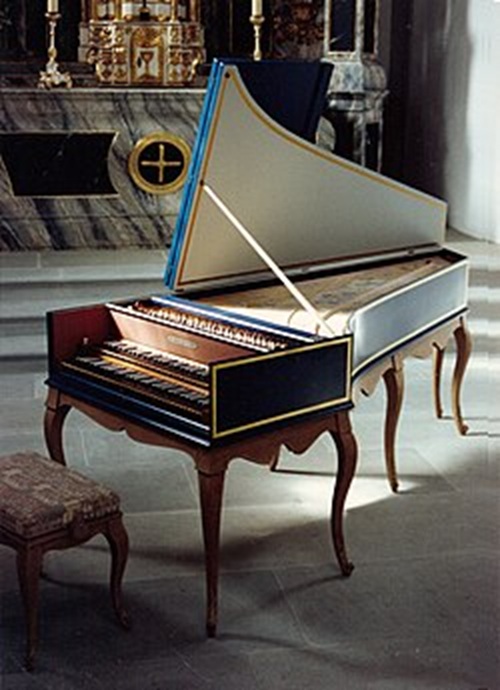
Do you know what happens when a harpsichord is tuned to Aron’s meantone temperament? First, the four “foundational perfect fifths” (C-G, G-D, D-A, A-E) are each narrowed by just under 3.5 cents compared to the perfect fifths of equal temperament. The resulting E note forms a pure major third with C. This E is a full 13.5 cents (3.5 × 4) lower than in equal temperament. Consequently, modulation to distant keys is impossible, as the notes are not enharmonically equivalent. Many CD recordings marketed as “meantone” actually employ a modified version of Aron’s temperament; in my view, the major thirds are likely widened slightly. This adjustment presumably prevents the interval between notes like G# and Ab from becoming too dissonant. Musicians such as Alan Curtis and Blandine Verlet are known for using temperaments other than equal temperament when performing the works of Louis Couperin. Yet, upon listening to their recordings, one senses that the intervals characteristic of meantone—specifically the semitones—have been “corrected.” If one were to tune an instrument strictly according to the theory of Aron’s meantone, the semitones would become quite wide. Why is this? For instance, if you derive the four foundational notes (perfect fifths) starting from C in C major, the F becomes significantly high, whereas the E is low (by as much as 13.5 cents!). Naturally, this results in an “enormous” interval between E and F, and the same applies to the interval between B and C. However, in these recordings, the semitones do not sound nearly that wide; it is evident that the performers are conscious of the recording process. It is my contention that Aron’s meantone temperament is a system that requires constant adjustment. In other words, a concert program might be structured so that the first half consists of pieces in sharp keys; the performer then retunes during the intermission before playing a second half featuring pieces in flat keys. Furthermore, one might surmise that they employed practical adjustments—such as deriving the “four fundamental notes” from D rather than C.
In Rameau’s “Concert No. 1”, the first movement (“La Coulicam”) and the second movement (“La Livri”) are composed in C minor. This means the note sounding here is A-flat, not G-sharp. Yet, in Aron’s meantone temperament, these two notes are separated by an interval of approximately 41 cents *Note—nearly 40 percent of a semitone—making them distinct pitches with a palpable “discontinuity” between them. If, as my hypothesis suggests, musicians of that era avoided this tonal clash by retuning during the intermission or shifting their fundamental notes, it highlights just how unnatural the modern recording convention of playing an entire program using a single, fixed tuning actually is. However, if they had plunged into the C minor of “Livri” without altering the tuning, a different kind of drama would have unfolded. When an A-flat—pitched abnormally low relative to C (effectively a G-sharp)—blends into a chord, the resulting “wolf” distortion, with its tearing quality, would surely have sent shivers down the audience’s spines, evoking the very “tragic sighs” and “dramatic shadings” so beloved by the French of that time. Recordings by Alan Curtis and Blandine Verlet fail to capture this “raw, wide semitone” or the “fangs of the wolf”. Clearly conscious of the recording medium, they have “corrected” major thirds and semitones to sound milder. This is not to say their refined performances are flawed. However, having been captivated by the “wild dynamism” and the earth-shaking, expansive semitone trills inherent in Aron’s specific tuning method, I find it deeply regrettable that the meantone temperament captured on modern CDs often sounds—to my ears—like something caged and castrated. Surely, the true essence of meantone temperament lies not in some theoretical, symmetrical beauty, but rather in the raw, earthy, yet lavish “living breath” of the harpsichordists of that era—musicians who constantly adapted the sound in the heat of performance, even taming the “poison” of the wolf interval and transforming it into a source of pleasure.
*Note: To obtain these two notes, the following procedure is required: for G#, one stacks mean-tone fifths upwards eight times starting from C, whereas for A♭, one stacks mean-tone fifths downwards four times starting from C. The resulting pitches differ from equal temperament: G# is 27.4 cents lower, and A♭ is 13.7 cents higher. Adding these cent values together yields a total difference of 41.1 cents. #AronMeantone #Rameau #Concerts #Tuning #Harpsichord #片山俊幸
——————————————————————————–
The Logic of Well-Temperament: Werckmeister III vs. Kirnberger III
The Logic of Well-Temperament: Werckmeister III vs. Kirnberger III
In the era of J.S. Bach, when musicians began to crave the freedom to play in all 24 keys without the brutal roar of the meantone “wolf,” two specific tuning systems emerged as the frontline solutions: Werckmeister III and Kirnberger III.
What is fascinating—and often overlooked—is that mathematically, these two temperaments are constructed from the exact same “ingredients.” Yet, simply by altering where these ingredients are placed, they create entirely different musical universes.
To understand their architecture, let us recall the foundational measurements:
・Pythagorean Fifth: ~701.96 cents
・Meantone Fifth (1/4 comma): ~696.50 cents
・Equal Temperament Fifth: 700.00 cents
Both systems face the same task: closing the circle of 12 fifths (totaling 8,400 cents) by balancing the Pythagorean comma (23.52 cents) against the syntonic comma (21.84 cents).
1. Werckmeister III: The Pragmatic Equalizer
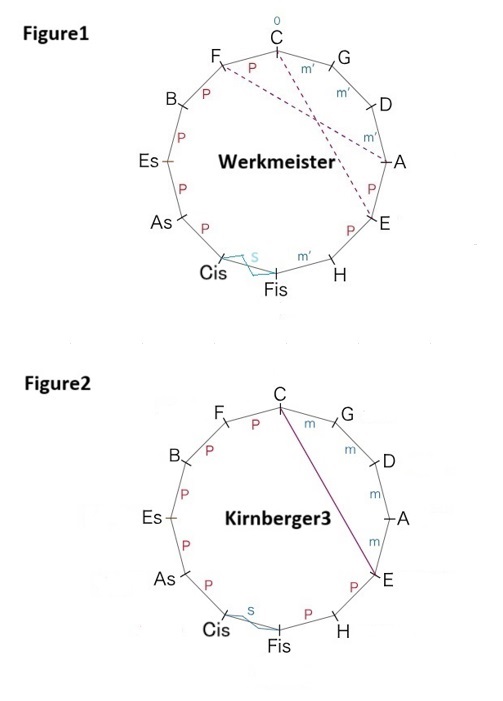
Andreas Werckmeister’s brilliant idea was to scatter the wolf’s fangs across the keyboard. He took four meantone fifths and placed them at C-G, G-D, D-A, and skipped ahead to B-F♯. The remaining seven fifths (A-E, E-B, and the flat side C-F, F-B♭, B♭-E♭, E♭-A♭) are left as pure Pythagorean fifths.
To close the circle, the final remaining fifth, F♯-C♯, absorbs the residual mathematical error (adjusted by subtracting the schisma of 1.68 cents, becoming ~700.28 cents).
・The Math: (696.50 × 4) + (701.96 × 7) + 700.28 = 8,400 cents
By breaking up the consecutive chain of narrowed fifths, Werckmeister achieved a revolutionary smoothness. None of the keys sound perfectly pure, but none of them collapse into unusable distortion either. It is closer in spirit to modern equal temperament.
2. Kirnberger III: The Melancholic CompromiseJohann Kirnberger (a pupil of Bach) took the exact same ingredients but refused to let go of the past. He kept the four meantone fifths chained together consecutively: C-G, G-D, D-A, and A-E. He then assigned the next seven intervals as Pythagorean fifths, leaving F♯-C♯ to absorb the same residual adjustment (~700.28 cents).
・The Math: (696.50 × 4) + (701.96 × 7) + 700.28 = 8,400 cents
Because Kirnberger kept the four meantone fifths unbroken from C to E, he preserved one single, untainted, pure major third: C-E.
The Verdict
Here lies the beautiful paradox of well-temperament. Though their mathematical formulas look almost identical on paper, their musical impact is polarized.
Werckmeister III leans toward the modern world—pragmatic, balanced, and democratic, allowing smooth transitions across all keys. Kirnberger III, however, is a landscape of extremes. It gives you the heavenly purity of a perfect C-major chord, but forces you to pay for it with harsher, stranger colorations as you wander into distant keys.
As a harpsichordist, playing Bach on these two systems reveals that well-temperament was never about making everything sound “equal”—it was about deciding exactly how much of the old meantone magic you were willing to sacrifice for the sake of freedom. #Werckmeister #Kirnberger #WellTemperament #BaroqueTuning #Harpsichord #片山俊幸
——————————————————————————–
The Elegance of Vallotti and the “Beautiful Hesitation” of Western Music
The Elegance of Vallotti and the “Beautiful Hesitation” of Western Music
As the Baroque era progressed, the quest for a fluid, universal tuning system led to the creation of the most elegant, near-symmetrical unequal temperaments of the 18th century: Vallotti and Young.
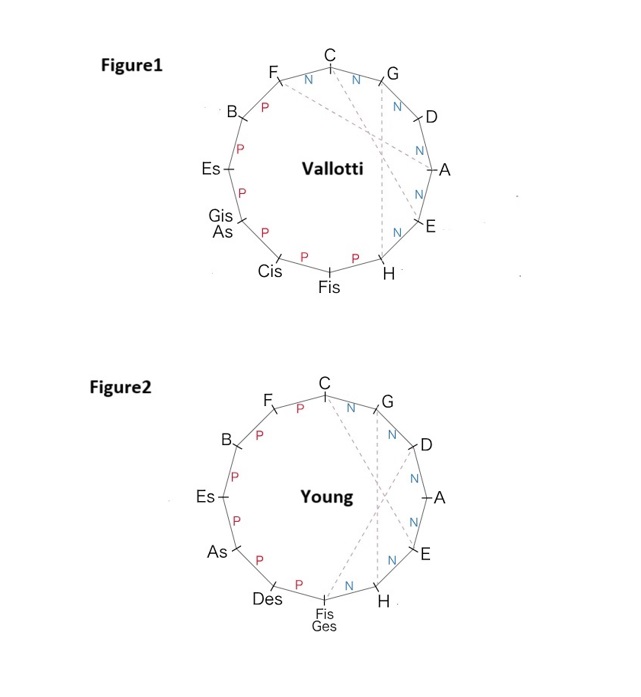
Mathematically, Francescantonio Vallotti’s system is a masterpiece of balance. He narrowed six specific fifths by 1/6 of a syntonic comma, left five fifths completely pure (Pythagorean), and allowed the final fifth to absorb the remaining schisma (~1.68 cents) to close the circle.
・The Traditional Calculation: (696.50 × 6) + (701.96 × 5) + 700.28 = 8,400 cents
Because Vallotti did not specify exactly where the schisma-adjusted fifth should go, the system is universally interpreted today by narrowing six consecutive fifths by 1/6 of the Pythagorean comma and leaving the other six entirely pure.
The Modern Interpretation: (701.96 – 23.52/6) × 6 + (701.96 × 6) = 4,188.24 + 4,211.76 = 8,400 cents
When Thomas Young shifted this exact circle to start from C rather than F, he created Young’s Temperament. Both systems achieved what the earlier Well-Temperaments could only approximate: a seamless, highly democratic circulation through all 24 keys, where every key retains a unique, subtle coloration without a single hint of a destructive wolf.
The Intersection of Physics, Math, and Harmony
Physics exists precisely at the midpoint between mathematics and music. It was Pythagoras (born 582 BC) who first attempted to explain music through numbers—or perhaps numbers through music. For centuries, Europe remained blindly loyal to his system of pure fifths. But as the Renaissance introduced intervals Pythagoras never accounted for—such as the major third, minor third, and seventh—the art of temperament was born, triggering a 200-year battle against the laws of acoustics.
Eventually, around 1750, Europe finally “discovered” and embraced Equal Temperament.
Yet, on the other side of the world in China, a scholar named Zhu Zaiyu (朱載堉) had already calculated and mathematically perfected Equal Temperament around the year 1600. Why did it take Europe nearly a century and a half longer to reach the same mathematical conclusion?
The answer lies in a single word: Harmony.
Because traditional Chinese music was predominantly melodic and monophonic, Zhu Zaiyu could adopt the mathematical purity of equal temperament without hesitation. Europe, however, was deeply entangled in the lush, sensual world of polyphony and triadic harmony. European ears had tasted the heavenly bliss of the pure major third offered by meantone tuning. To accept equal temperament meant intentionally making every single major third out of tune (by roughly 14 cents) for the sake of utility.
Europe’s delay was not a failure of intellect, but a hesitation born of love. They were deeply reluctant to sacrifice the purity of their chords. This reluctance forced centuries of brilliant physicists and musicians into an agonizing, beautiful struggle—producing experimental tunings like Werckmeister, Kirnberger, and Vallotti—before they finally surrendered to the utilitarian cage of equal temperament. #Vallotti #ThomasYoung #ZhuZaiyu #EqualTemperament #BaroqueMusic #TuningHistory #Harpsichord #片山俊幸
——————————————————————————–
The Enigma of Bach’s Tuning: Deciphering the Curls and the Whispers of the Ears
The Enigma of Bach’s Tuning: Deciphering the Curls and the Whispers of the Ears
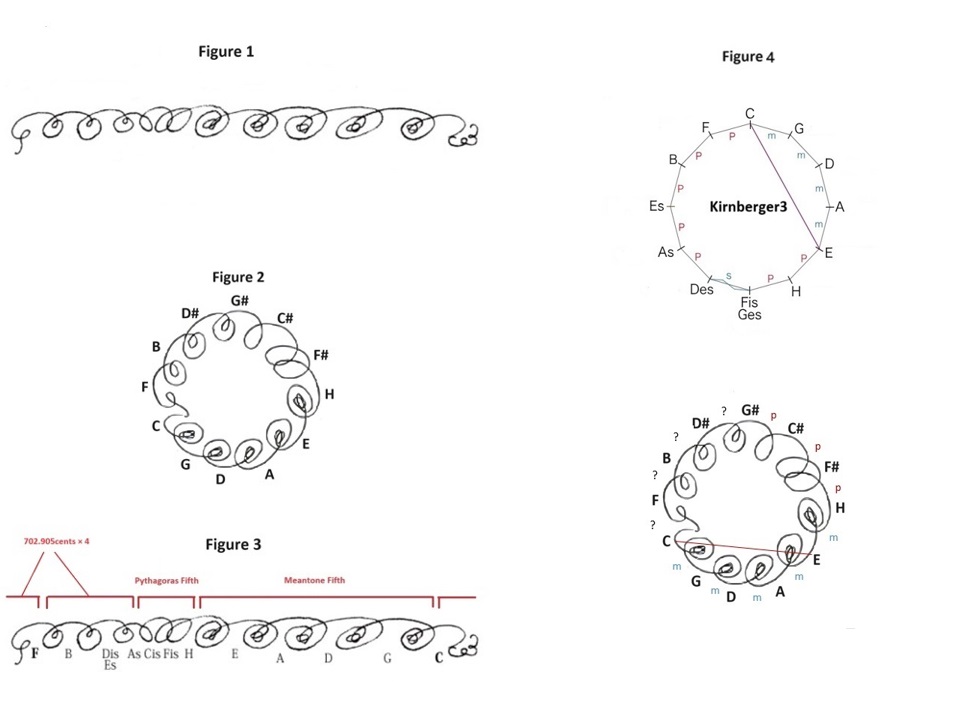
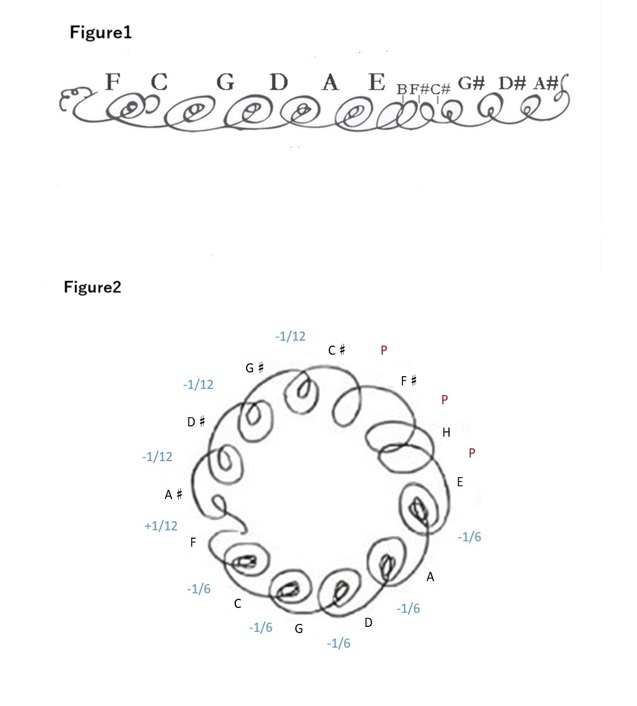
What did J.S. Bach truly mean by “The Well-Tempered Clavier”? In 1999, a mathematician named Andreas Sparschuh triggered a revolution by suggesting that the mysterious, calligraphic scroll loops drawn atop Bach’s 1722 autograph title page were not mere decoration, but a coded blueprint for a tuning system.
Among the various attempts to decode this “Rosetta Stone,” the 2005 hypothesis by French harpsichord maker Émile Jobin offers a profoundly organic, historically convincing perspective.
Jobin read the loops not with the sterile detachment of modern formulas, but through the traditions of the pipe organ and French harpsichord music. He identified three types of loops representing three distinct flavors of fifths:
1.Triple Loops (5 intervals): Meantone fifths (~696.50 cents), chained to secure two completely pure, heavenly major thirds (C-E and G-B).
2.Single Loops (3 intervals): Pure Pythagorean fifths (~701.96 cents).
3.Double Loops (4 intervals): The residual, wider fifths (~702.91 cents) that absorb the mathematical friction.
・The Proof: (696.50 × 5) + (701.96 × 3) + (702.91 × 4) = 3482.5 + 2105.88 + 2811.64 = 8,400 cents.
By allowing these double-looped fifths to stand slightly wider than a pure Pythagorean fifth, Jobin’s Bach temperament achieves a stunning paradox: a system where you can freely navigate all 24 keys, yet still retain the fierce, tear-inducing emotional contrast between pristine thirds and howling dissonances. It is a world away from the cold, uniform landscape of Kirnberger III.
The Reality Under the Fingers: Shunning the Machine
Modern physics tells us that if you systematically narrow every single fifth by roughly 2 cents (1/12 of a Pythagorean comma), you automatically construct Equal Temperament. But let us be honest: “cents” are a modern fiction. They require electronic measurement. Bach’s world was governed entirely by the human ear.
To realize his tuning, Bach relied 100% on interpreting “beats”—the physical friction and acoustic interference between interacting strings. He tuned not by looking at numbers, but by listening to the rhythmic breathing of the intervals.
Yet, there is a fascinating, historically plausible alternative that we rarely consider: The Lute.
While keyboard players were agonizing for two centuries over the geometry of major thirds, lutenists had already implemented Equal Temperament out of sheer necessity. Because the frets of a lute run straight across all six strings, any attempt to use unequal temperaments or meantone would throw the other strings into immediate, unplayable chaos. The lute is, by its very physics, an equal-tempered instrument.
Bach, a close friend of the legendary lutenist Sylvius Leopold Weiss, was deeply familiar with the instrument and even owned a lute-harpsichord (Lautenwerck). Is it possible that Bach bypassed the tortuous calculations of keyboard theorists simply by aligning his harpsichord’s unisons and octaves to the geometric frets of a well-strung lute?
Ultimately, whether Bach tuned by the intricate kabbalah of the title-page loops or by the practical shortcuts of a lutenist’s ear, one truth remains: the Well-Tempered Clavier was not a manifesto for a sterile, mathematically perfect average. It was a playground designed for an ear that was sharp enough to master the wolf, practical enough to tune a harpsichord in fifteen minutes, and artistic enough to demand that every key possess its own living, breathing soul. #JSBach #WellTemperedClavier #EmileJobin #Harpsichord #BaroqueTuning #Lute #TuningHistory #片山俊幸
——————————————————————————–
The Bach Tuning Enigma Part II: A Counterargument to Bradley Lehman’s Hypothesis
The Bach Tuning Enigma Part II: A Counterargument to Bradley Lehman’s Hypothesis
Following my previous discussion on Émile Jobin’s reading of Bach’s title-page loops, we must confront the alternative, highly influential—and fiercely debated—hypothesis proposed by Bradley Lehman.
Having engaged in frequent, lively debates with Dr. Lehman himself on Facebook regarding this very subject, I was prompted to analyze his mathematical model deeply. Lehman turns Bach’s loops upside down (viewing them from the reverse side) and constructs a circle of fifths starting from F.
His breakdown utilizes fractions of the Pythagorean comma (23.52 cents):
1.Triple Loops (5 intervals): Pythagorean Fifth minus 1/6 comma (~698.04 cents)
2.Single Loops (3 intervals): Pure Pythagorean Fifth (~701.96 cents)
3.Double Loops (3 intervals): Pythagorean Fifth minus 1/12 comma (~700.00 cents)
4.The F-A♯ connection (1 interval): Pythagorean Fifth plus 1/12 comma (~703.92 cents)
・The Verification: (698.04 × 5) + (701.96 × 3) + (700.00 × 3) + 703.92 = 3490.2 + 2105.88 + 2100.00 + 703.92 = 8,400 cents.
Mathematically, Lehman’s solution closes the circle perfectly. But it introduces a profound historical and philosophical paradox that I must challenge.
The Fatal Flaw: The 1/12 Comma Paradox
Look closely at Lehman’s third ingredient: “Pythagorean Fifth minus 1/12 comma.” This turns out to be exactly 700.00 cents—the precise interval of a modern Equal Tempered fifth.
This is where Lehman’s theory inadvertently undermines its own premise. If Johann Sebastian Bach possessed an ear so superhumanly precise that he could intentionally tune a perfect -1/12 comma interval by ear, and if he willingly used it for three specific fifths, a glaring question arises:
Why on earth didn’t he just tune all 12 intervals that way and achieve Equal Temperament?
If Bach had the technical capability and the acoustic vocabulary to grasp and execute the -1/12 comma temperament, the conceptual leap to 12-Equal Temperament would have been instantaneous and effortless. The fact that he didn’t prove that the “Well-Tempered Clavier” was a deliberate rejection of mathematical uniformity.
Conclusion: The Ear vs. The Diagram
This is the issue with decoding Bach’s scroll purely through an academic lens. Theorists like Lehman see a static diagram to be solved like a Sudoku puzzle. But as a harpsichordist who listens to the strings, I know that tuning is an act of live compromise.
Bach did not avoid equal temperament because he lacked the math; he avoided it because he loved the distinct, shifting characters of the keys. By forcing a modern 700-cent equal-tempered fifth into the baroque grid, Lehman’s model tries to make Bach look like a modern progressive. But Bach was a craftsman of the ear.
The true “Well-Tempered” system was not a stepping stone toward the gray, democratic compromise of equal temperament. It was a conscious choice to keep the keys unequal, keeping the music alive, colorful, and dangerous. #BradleyLehman #JSBach #WellTemperedClavier #BaroqueTuning #Harpsichord #Musicology #片山俊幸
——————————————————————————–
The Complete Works of Louis Couperin / Jean Rondeau
The Complete Works of Louis Couperin / Jean Rondeau
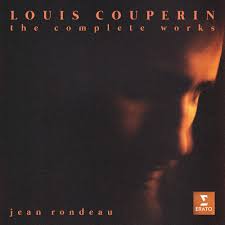
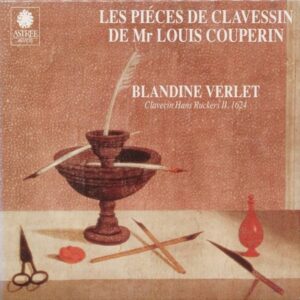
The much-hyped Jean Rondeau complete collection of Louis Couperin has finally been released. Louis Couperin’s complete works for harpsichord have been recorded by Blandine Verlet, Christophe Rousset, Davitt Moroney, and Massimo Berghella, among others. I previously reviewed Blandine Verlet (the teacher of Jean Rondeau), but what’s new about Jean Rondeau’s latest recording is that it encompasses not only harpsichord pieces but also organ and chamber music. This is a substantial CD. Listening to the entire set takes quite a while, but it offers some innovative ideas, such as the organ rendition of the Pavane in F-sharp minor and the other harpsichord numbers, originally composed for harpsichord. There are three tracks of this Pavane, including one for a viol consort and harpsichord, but the organ track appears to be transposed to G minor. The reason is that this key would produce a distorted sound if tuned normally, and while it is relatively easy to change the tuning of a harpsichord, it is difficult to do so with an organ. Another highlight of this record is the use of a variety of instruments, including Rückers’ originals. There are also works by various composers in that time scattered throughout the album, which is enjoyable. Also, in the 10th piece on the first CD (“a prelude imitating Froberger”), Rondeau has a bit of mischief in him. He uses a fortepiano, which would not have existed in Couperin’s time. Below are the pieces and the instruments used: #baroque #louiscouperin #jeanrondeau #片山俊幸
https://www.facebook.com/groups/1087954046763597/?multi_permalinks=1420345306857801
P.S.
Regarding “Jean Rondeau – Prelude in the Imitation of Mr. Froberger”
The version I possess is a download from Spotify, but it appears that a file unrelated to this series had been mistakenly included with the track. I have decided to post that file here as evidence.
https://excelkobo.net/music/Couperin,L_Suite_en_la_IPrelude_a_l’imitation_de_Froberger,G.6.m4a
While this was a mistake on Spotify’s part. Additionally, as the correct version of the track has been uploaded to YouTube, I am including the link here.
https://www.youtube.com/watch?v=B6K8etukky4
——————————————————————————–
Jean Rondeau’s Pavane by Louis Couperin
Jean Rondeau’s Pavane by Louis Couperin
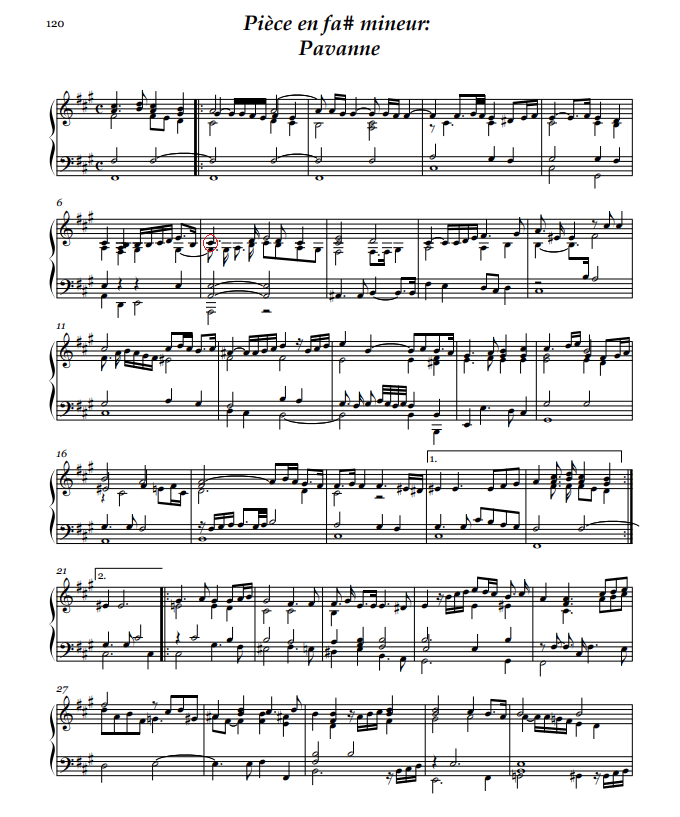
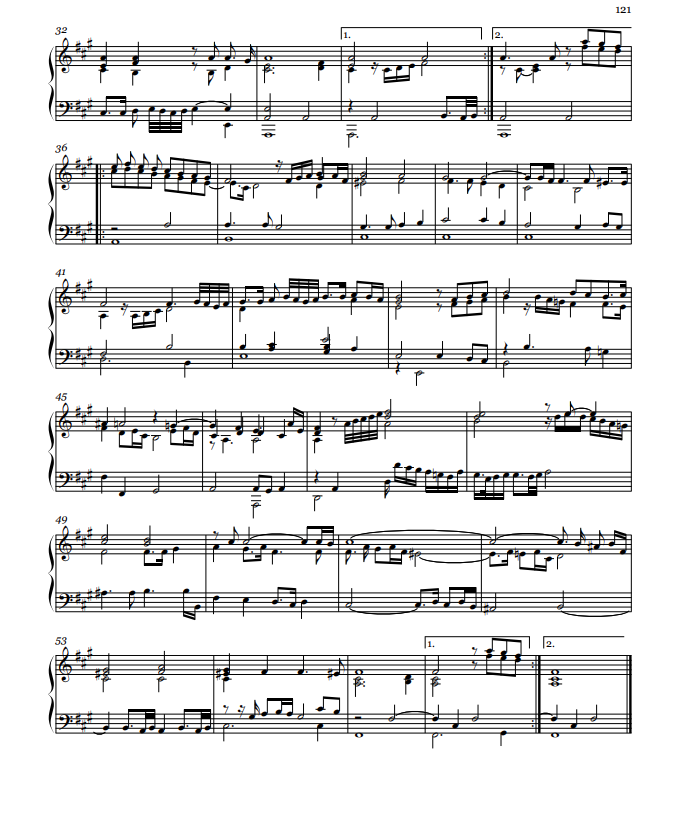
Since the release of Jean Rondeau’s complete collection of works by Louis Couperin, I have listened to it several times; among the tracks, the piece Rondeau focuses on with particular care is the “Pavane (G.120)”. The set includes four versions: two performed on the harpsichord, one on the organ, and one by a viol consort. Of the harpsichord performances, the first uses an original 1624 Ruckers instrument, while the second uses a copy built by David Ley based on a Jacques Thibaut original. Initially, I assumed the organ version was transposed to G minor, but that turns out not to be the case. It appears the organ at Notre-Dame de Juvigny is tuned to A=440Hz—roughly a whole tone higher than the pitch typically used for French harpsichords—meaning Rondeau is actually playing the piece in E minor. This can be confirmed via a YouTube video. The piece’s original key, F-sharp minor, was considered quite daring—and “poor-sounding”—at the time. The Notre-Dame de Juvigny organ seems to be tuned not to meantone, but to one of the “well-tempered” systems used in France during that era. Rondeau appears to have adopted a “well-tempered” tuning for the harpsichord as well, as there are no jarringly dissonant chords. This brings to mind the recording of this piece by Blandine Verlet (Rondeau’s teacher). She seems to have performed it using standard meantone tuning (C-G-D-A-E Aaron’s meantone), resulting in the frequent appearance of the “wolf” interval throughout the piece—though, for my part, I find that performance to have a unique charm of its own. Rondeau, however, was not content to stop there; he also had the piece performed by a viol quartet. Needless to say, this version offers the sound of flawless, pure harmonies. The performance reflects Rondeau’s distinctive approach. #louiscouperin #jeanrondeau #clavecin #organ #viol #片山俊幸
P.S.
So, what kind of tuning did Blandine Verlet use for this piece? From here on, I’ll state that this is all merely speculation. Listening to the score, one thing becomes clear: the D# and E# are high. Anyone listening to the melody line should notice this. Verlet likely didn’t tune the D# from H with no beat, as is typical for sharp-based pieces, but rather tuned it in a different way. I don’t know what that method was. Similarly, for the E#, I suspect it wasn’t tuned with no beat A-C#-E#, but rather tuned it in a different way. Either way, there’s no doubt that the tuning method was such that these two notes were high. One possibility is that she tuned it one quarter comma of fifth below C (a mean-tone fifth). If that’s the case, it would explain, to some extent, the distortion of the melody.
——————————————————————————–
The Collapse of the Lehman Hypothesis: Wishful Thinking vs. 18th-Century Common Sense
The Collapse of the Lehman Hypothesis: Wishful Thinking vs. 18th-Century Common Sense
When I previously confronted Dr. Bradley Lehman on Facebook with a fatal question—”If Bach could intentionally tune a perfect -1/12 comma (Equal Tempered) fifth by ear, why didn’t he just tune the whole instrument to Equal Temperament?”—his response was telling. Instead of a theoretical or historical defense, he merely argued that his tuning “simply sounds better than equal temperament”.
With all due respect, that is not an academic answer; it is a retreat into subjective preference. It proved that when cornered by the practical realities of the ear, his mathematical house of cards collapses.
Today, I am breaking my silence to share the counterargument that completely exposes the wishful thinking behind the Lehman hypothesis, rooted in two fatal flaws and the reality of 18th-century craftsmanship.
1. The Double Artifice: Upside Down and F-Centric
There are two glaring logistical gymnastics that Lehman requires us to accept, which Émile Jobin’s far more honest hypothesis safely avoids:
・Why did Lehman have to flip Bach’s diagram upside down?
・Why did he have to arbitrarily force the starting point of the circle of fifths to be F?
When you have to literally invert a historical manuscript and distort its geometry just to make the numbers fit your predetermined solution, you are no longer deciphering Bach—you are forcing Bach to play your own game. It is the very definition of cherry-picking evidence.
2. The Vocabulary of the 18th-Century EarIf you study the evolution of historical temperaments thoroughly, it becomes undeniable that 18th-century builders worked with a specific, practical vocabulary of the ear. Their entire sonic universe was built upon just two standard, universally recognized “yardsticks”:
・The Meantone Fifth (narrowed)
・The Pythagorean Fifth (pure)
This was the “common sense” of the Baroque era. The entire philosophy of Well-Temperament (such as Werckmeister III or Kirnberger III) was simply a matter of combining these two highly familiar intervals, and then steering the inevitable remaining mathematical friction (the error) into a manageable area. (Systems like Vallotti’s -1/6 syntonic comma were the rare exceptions, not the rule).
Yet, Lehman smuggles a third, completely foreign concept into Bach’s grid: a -1/12 Pythagorean comma (the modern Equal Tempered fifth), hidden sneakily in three specific locations.
To suggest that Bach casually utilized the hyper-specific -1/12 comma is an anachronism. It assumes Bach was thinking like a modern digital tuner. If Bach genuinely possessed the concept and the auditory capability to isolate a -1/12 comma, it is an insult to his genius to suggest he wouldn’t have instantly flattened the entire circle into true Equal Temperament.
Conclusion
Bach was a man of his time—a towering genius, yes, but a practical craftsman who shared the acoustic vocabulary of his contemporary builders. He did not need to flip diagrams upside down, nor did he need modern decimal points.
Lehman’s theory is a modern mirror masquerading as a historical window. It attempts to make Bach look brilliant by modern standards, but in doing so, it robs him of his actual, 18th-century mastery. The “Well-Tempered Clavier” was not born from the intricate math of a inverted scroll; it was born from a craftsman who combined the standard tools of his trade—meantone and Pythagorean fifths—with an ear so sublime that he turned the friction of the universe into pure art. #BradleyLehman #JSBach #WellTemperedClavier #BaroqueTuning #Harpsichord #Musicology #Counterargument #片山俊幸
——————————————————————————–
About boy soprano
About boy soprano
With very few exceptions, Bach’s vocal music was written for boy sopranos, not female sopranos. In those days, women did not sing in German churches. Sopranos were supposed to be boys, and altos were supposed to be sung by boys or counter-tenors (although doubts remain about counter-tenors). Today, most concerts and CD recordings are sung by women, but this is actually a mistake. It is akin to having a woman play the female role in Kabuki, which can be called a destruction of tradition.
The complete Bach cantatas have been recorded by Helmuth Rilling, Ton Koopman, John Eliot Gardiner, Masaaki Suzuki, and others. I own the complete CD collection of Gustav Leonhardt and Nikolaus Harnoncourt(Das Kantatenwerk). This was recorded by Leonhardt and Harnoncourt on the Telefunken label over a period of 18 years, from 1970 to 1988, sharing the music. The complete works were originally released on LP records, and all the pieces were accompanied by scores (of the old Bach Complete Works Edition). At the time, I had two rich friends who were both doctors, and I used to envy them when I went to their homes and saw all the volumes of this series lined up on their shelves.
As far as I know, this is the only complete Bach cantata series recorded by a boy soprano, both solo and choral. Leonhardt uses the “Tölzer Knabenchor”, and Harnoncourt uses the “Vienna Boys Choir”. Leonhardt also recorded the “Matthew Passion” with boy soprano only, which is a must listen.
The appeal of the boy soprano lies in its fragility. The life of a boy soprano begins at the age of six or eight and ends suddenly at the age of twelve or three. Therefore, both Harnoncourt and Leonhardt selected as many boy soloists as possible from each choir and assigned them songs suitable for their voices. They must have given each of them a small number of pieces and trained them intensively. There is always the possibility of a sudden change of voice during the recording. That’s why many boy sopranos were replaced during the recording period of almost 18 years. The “angelic voice” would suddenly return to heaven one day. In other words, recording a boy soprano is a “race against time”. In the case of recordings using women as soloists, there is no such difficulty at all. She could probably sing the entire collection by herself.
In addition to this series, there are other recordings of Bach cantatas performed on original instruments by Ton Koopman, Masaaki Suzuki, and John Eliot Gardiner, but only the Leonhardt/Harnoncourt recording can be called an “original” performance in the true sense of the word. As for the orchestral performances themselves, Koopman’s Amsterdam Baroque Orchestra and Masaaki Suzuki’s Bach Collegium Japan are probably far superior. In particular, Harnoncourt’s Concentus Musicus Wien is quite inferior in terms of the skill of its woodwind players. The Leonhardt ensemble, with Frans Brüggen and other virtuosos, is absolutely impeccable, but even if you take that out of the equation, the use of a boy soprano in this series is truly a milestone. It should be called a “monumental tower” in the recordings of the twentieth century.
Many people don’t seem to understand my expression “the fragility of boy sopranos”. It may be natural. But this is a self-evident truth for many Japanese people. In the latter part of my article, I say “The life of a boy soprano begins at the age of six or eight and ends suddenly at the age of twelve or three”. Without fear of being misunderstood, this is the reason why Japanese people love cherry blossoms. Cherry blossoms bloom en masse but are destined to fall within a few days. We Japanese find the same beauty in the boy soprano.
And as I stated in “Use of original instruments in Bach performances” my argument is not that of a “misogynist”. But as expected, there is no shortage of people who call me a “misogynist”. Please don’t read my one and only posting and jump to conclusions. I would like them to read my other articles as well.
https://www.facebook.com/groups/110859412305172/posts/5120294791361584
Others make a fuss about boy sopranos as a matter of “human rights”. In other words, it is “unjust child labor” imposed on boys in the Baroque era. I can refute this in one word. One can ask one of the members of the Wiener Sangerknaben or the Tölzer Knabenchor, “Do you sing in the choir of your own free will or are you forced by your parents to do so?”
Others say that the conditions are different today than they were in Bach’s time, when boys did not change their voices until they were 17 or 18 years old. They conclude that this is why female sopranos should be used in the modern age. But is this really so? I want to listen to Bach’s musics played exactly as he described it. That is why I want to to listen to a boy soprano in church cantatas and a female soprano in secular cantatas.
One last thing must be said. I think it is extremely unfair and nonsensical to compare the “technique” of a female soprano with that of a boy soprano. Because she has plenty of time to practice and our angels do not have that time. They may go to heaven at any moment. But even with all of this, there are times when the charm of the boy soprano prevails. For example, Now I am comparing Cantata No. 84 (First Aria) between Masaaki Suzuki version and Nikolaus Harnoncourt version on CD, and the Harnoncourt version sung by Wilheim Wiedl is, to my eyes, more charming as music. Of course, it is a matter of personal preference. #boysoprano #treble #片山俊幸
https://excelkobo.net/bachwerke/BachWerke.html
——————————————————————————–
The Raving Frenzy of the Lehman Cultists and the Polyclerical Inquisitors
The Raving Frenzy of the Lehman Cultists and the Polyclerical Inquisitors
———-
<Bach and his Time>
Bradley Lehman
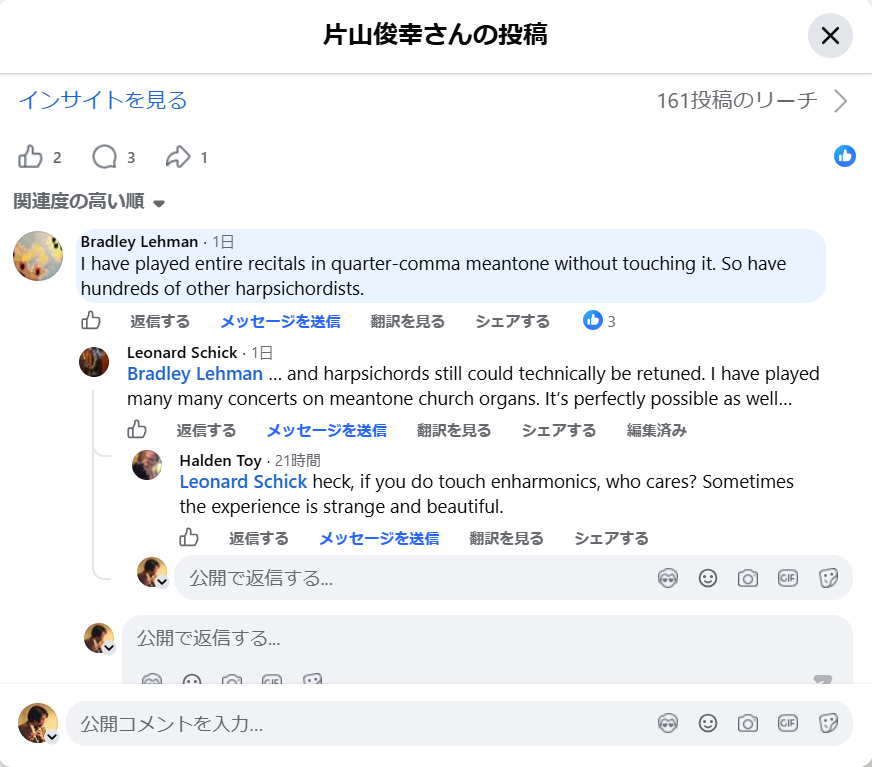
I have played entire recitals in quarter-comma meantone without touching it. So have hundreds of other harpsichordists.
Leonard Schick
Bradley Lehman … and harpsichords still could technically be retuned. I have played many many concerts on meantone church organs. It’s perfectly possible as well…
Halden Toy
Leonard Schick heck, if you do touch enharmonics, who cares? Sometimes the experience is strange and beautiful.
Bradley Lehman
Leonard Schick Yes. I either pick music that is going to fit the available temperament (especially on organ), or I work out a temperament that is going to fit the music that was already picked for the occasion.
Even though I am quick at converting harpsichord temperaments, and have done it pointedly for lecture-recitals that are about tuning, for more general performances (concert or church) I don’t make audiences listen to the tuning process.
———-
<Early Music Performance Practice>
Loren Ludwig
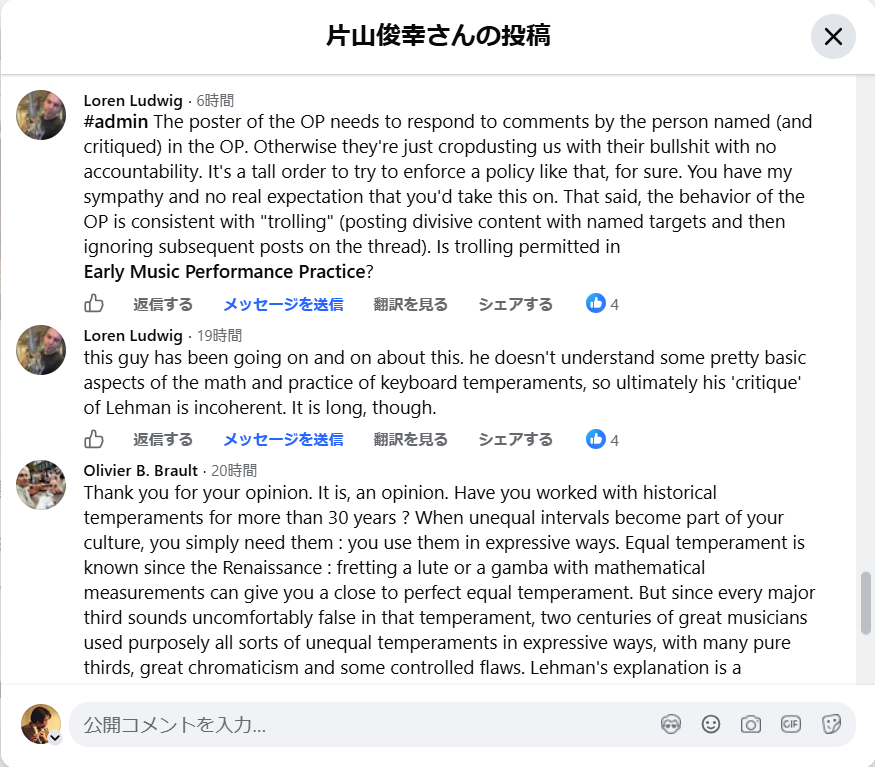
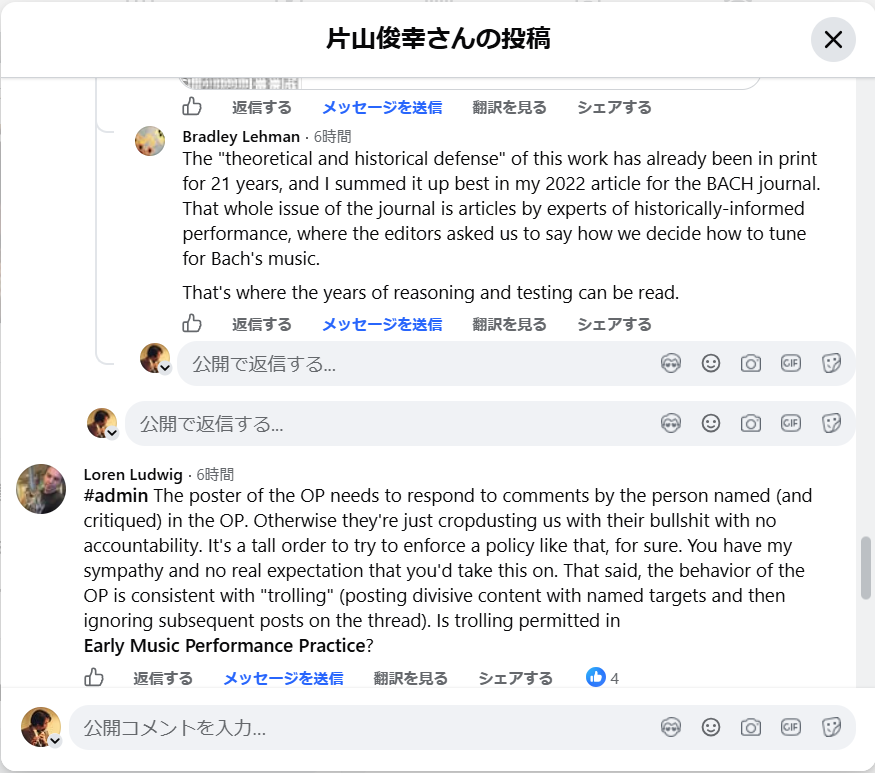
#admin The poster of the OP needs to respond to comments by the person named (and critiqued) in the OP. Otherwise they’re just cropdusting us with their bullshit with no accountability. It’s a tall order to try to enforce a policy like that, for sure. You have my sympathy and no real expectation that you’d take this on. That said, the behavior of the OP is consistent with “trolling” (posting divisive content with named targets and then ignoring subsequent posts on the thread). Is trolling permitted in Early Music Performance Practice?
Loren Ludwig
this guy has been going on and on about this. he doesn’t understand some pretty basic aspects of the math and practice of keyboard temperaments, so ultimately his ‘critique’ of Lehman is incoherent. It is long, though.
Olivier B. Brault
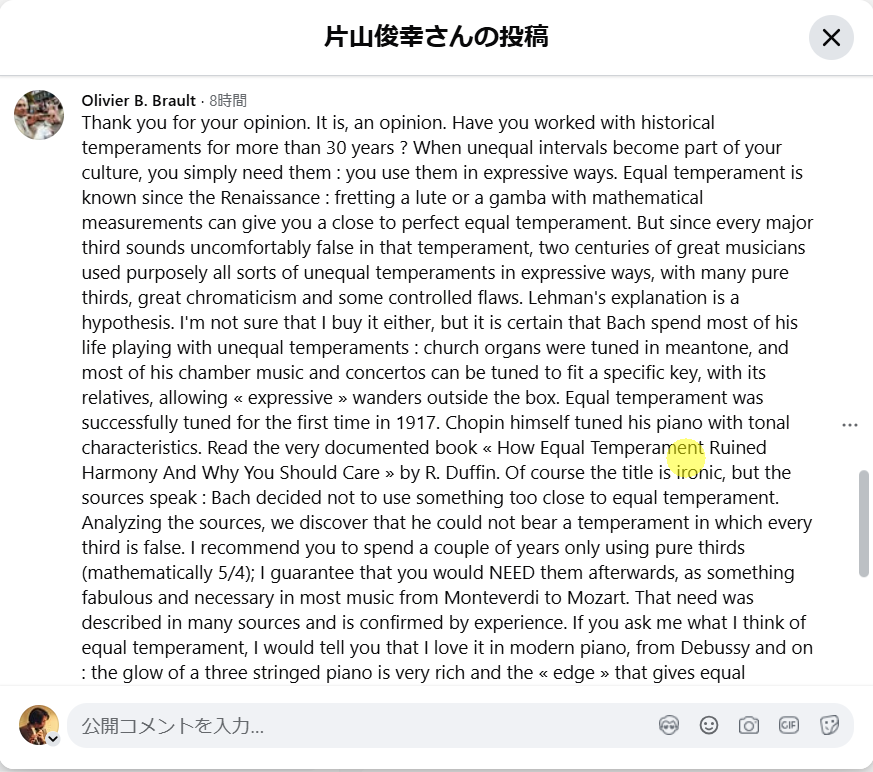
Thank you for your opinion. It is, an opinion. Have you worked with historical temperaments for more than 30 years ? When unequal intervals become part of your culture, you simply need them : you use them in expressive ways. Equal temperament is known since the Renaissance : fretting a lute or a gamba with mathematical measurements can give you a close to perfect equal temperament. But since every major third sounds uncomfortably false in that temperament, two centuries of great musicians used purposely all sorts of unequal temperaments in expressive ways, with many pure thirds, great chromaticism and some controlled flaws. Lehman’s explanation is a hypothesis. I’m not sure that I buy it either, but it is certain that Bach spend most of his life playing with unequal temperaments : church organs were tuned in meantone, and most of his chamber music and concertos can be tuned to fit a specific key, with its relatives, allowing « expressive » wanders outside the box. Equal temperament was successfully tuned for the first time in 1917. Chopin himself tuned his piano with tonal characteristics. Read the very documented book « How Equal Temperament Ruined Harmony And Why You Should Care » by R. Duffin. Of course the title is ironic, but the sources speak : Bach decided not to use something too close to equal temperament. Analyzing the sources, we discover that he could not bear a temperament in which every third is false. I recommend you to spend a couple of years only using pure thirds (mathematically 5/4); I guarantee that you would NEED them afterwards, as something fabulous and necessary in most music from Monteverdi to Mozart. That need was described in many sources and is confirmed by experience. If you ask me what I think of equal temperament, I would tell you that I love it in modern piano, from Debussy and on : the glow of a three stringed piano is very rich and the « edge » that gives equal temperament is tasteful. And it allows music to modulate freely and renders atonal art with great results. But it sounds uncomfortably dumb for music that was composed with tonality colours in mind, or simply pure thirds, like in baroque music.
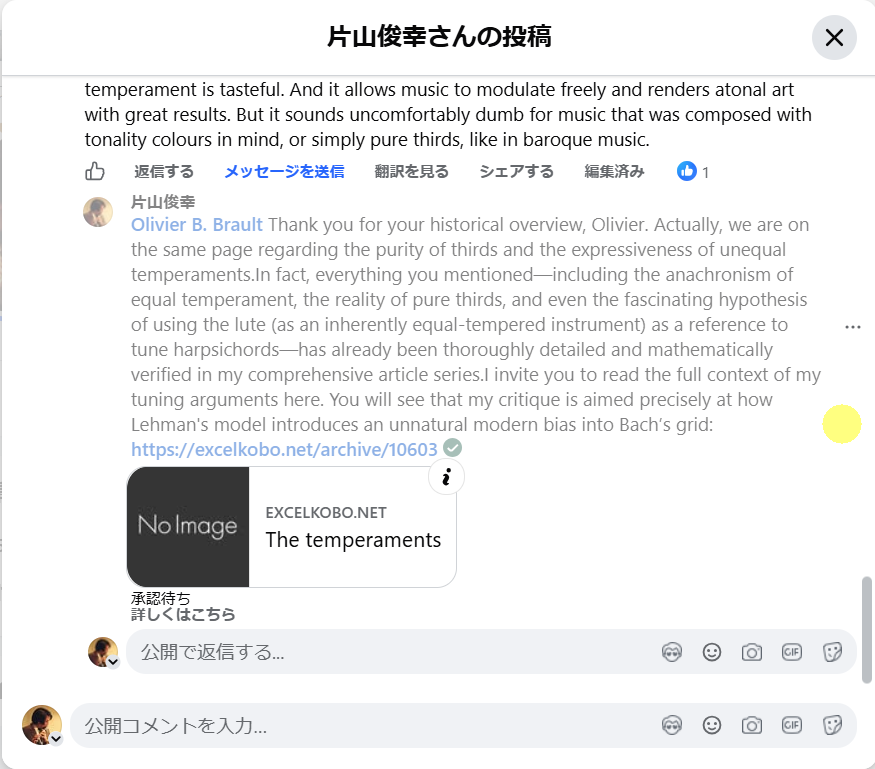
片山俊幸(hidden or deleted)click here*Please take a look at the screenshot.
Bradley Lehman
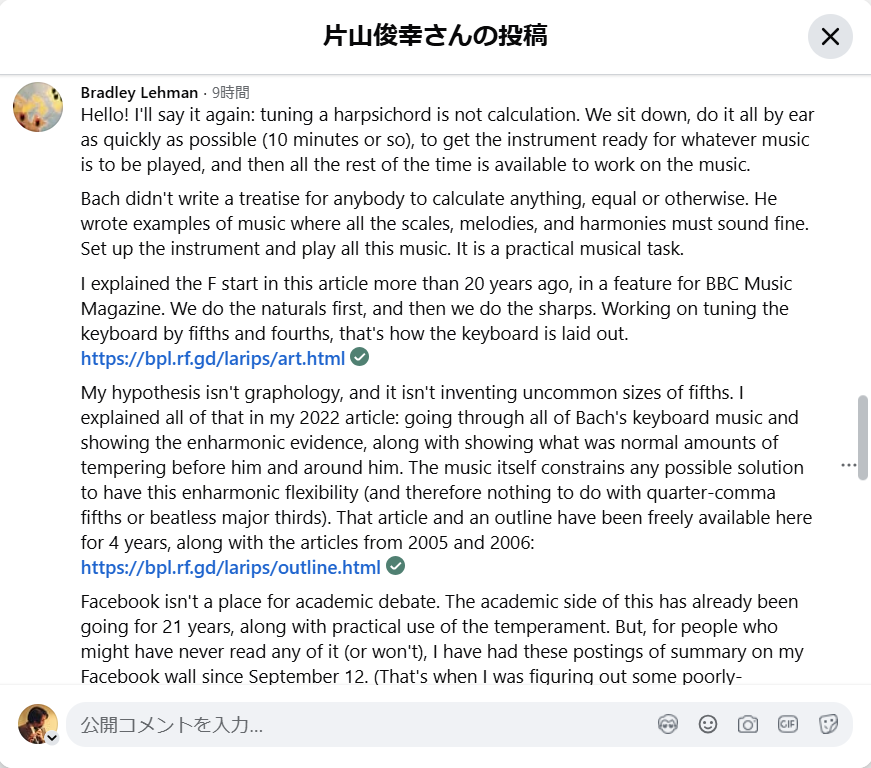
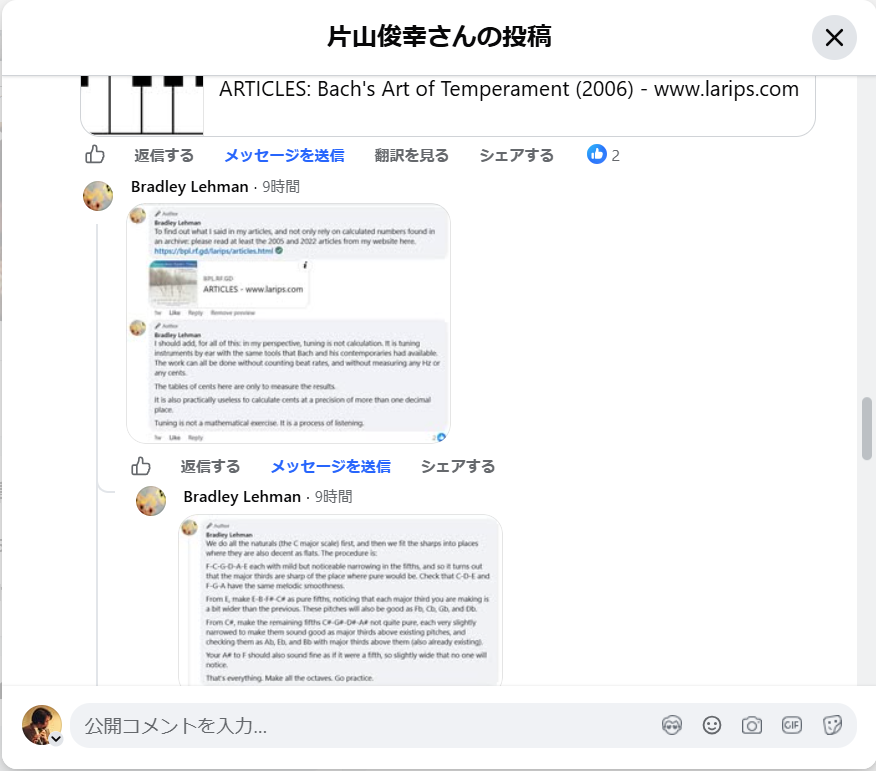
Hello! I’ll say it again: tuning a harpsichord is not calculation. We sit down, do it all by ear as quickly as possible (10 minutes or so), to get the instrument ready for whatever music is to be played, and then all the rest of the time is available to work on the music.
Bach didn’t write a treatise for anybody to calculate anything, equal or otherwise. He wrote examples of music where all the scales, melodies, and harmonies must sound fine. Set up the instrument and play all this music. It is a practical musical task.
I explained the F start in this article more than 20 years ago, in a feature for BBC Music Magazine. We do the naturals first, and then we do the sharps. Working on tuning the keyboard by fifths and fourths, that’s how the keyboard is laid out. https://bpl.rf.gd/larips/art.html
My hypothesis isn’t graphology, and it isn’t inventing uncommon sizes of fifths. I explained all of that in my 2022 article: going through all of Bach’s keyboard music and showing the enharmonic evidence, along with showing what was normal amounts of tempering before him and around him. The music itself constrains any possible solution to have this enharmonic flexibility (and therefore nothing to do with quarter-comma fifths or beatless major thirds). That article and an outline have been freely available here for 4 years, along with the articles from 2005 and 2006:
https://bpl.rf.gd/larips/outline.html
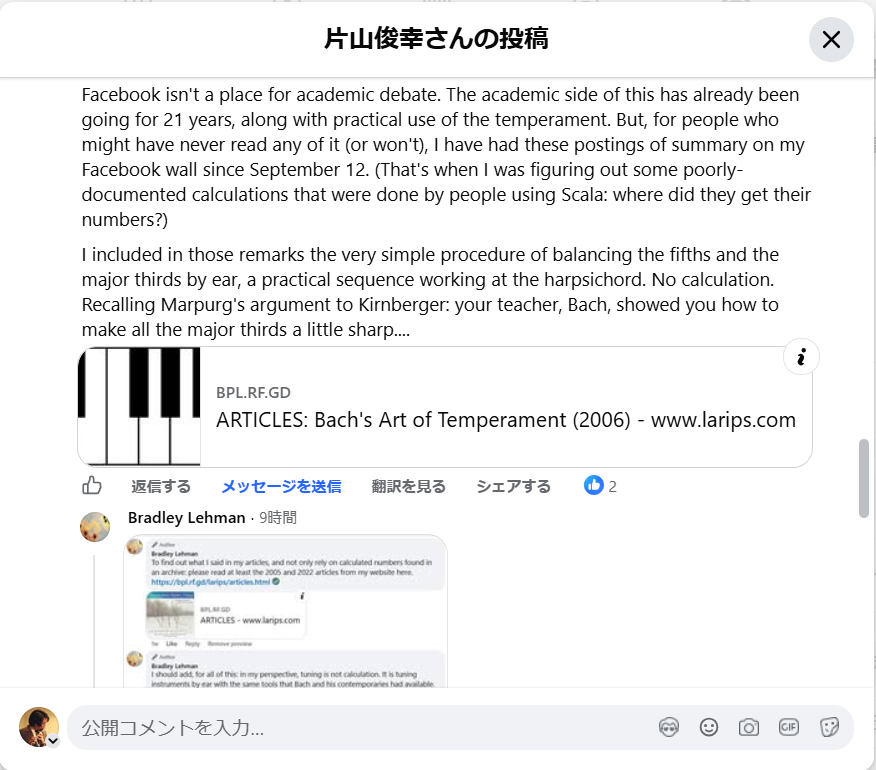
Facebook isn’t a place for academic debate. The academic side of this has already been going for 21 years, along with practical use of the temperament. But, for people who might have never read any of it (or won’t), I have had these postings of summary on my Facebook wall since September 12. (That’s when I was figuring out some poorly-documented calculations that were done by people using Scala: where did they get their numbers?)
I included in those remarks the very simple procedure of balancing the fifths and the major thirds by ear, a practical sequence working at the harpsichord. No calculation. Recalling Marpurg’s argument to Kirnberger: your teacher, Bach, showed you how to make all the major thirds a little sharp….
ARTICLES: Bach’s Art of Temperament (2006) – www.larips.com
BPL.RF.GD
ARTICLES: Bach’s Art of Temperament (2006) – www.larips.com
ARTICLES: Bach’s Art of Temperament (2006) – www.larips.com
Bradley Lehman PDF
Bradley Lehman PDF
Bradley Lehman PDF
Bradley Lehman PDF
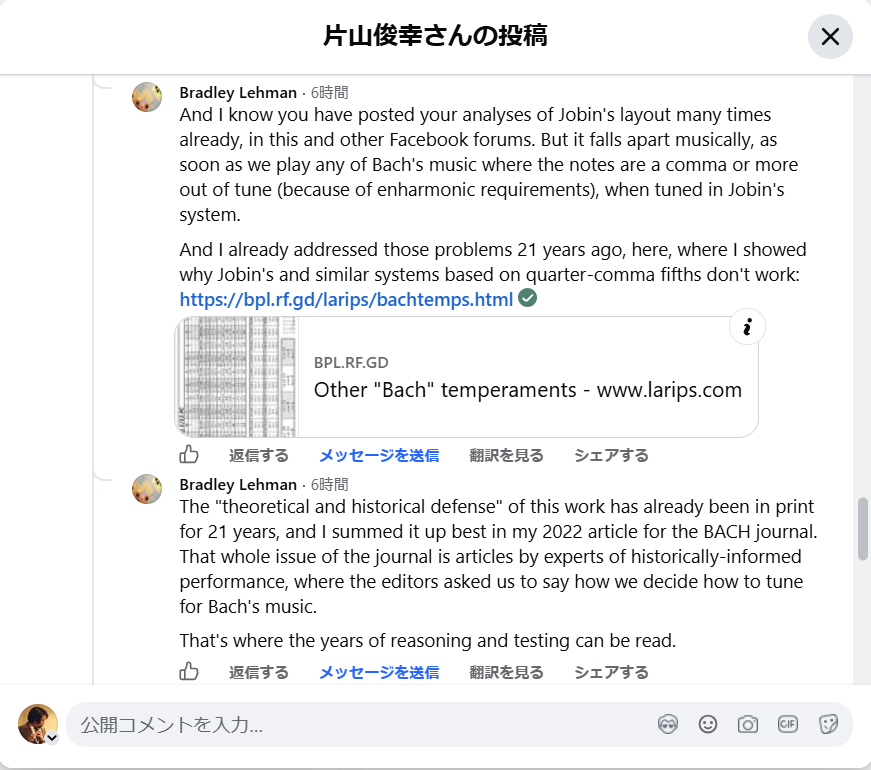
And I know you have posted your analyses of Jobin’s layout many times already, in this and other Facebook forums. But it falls apart musically, as soon as we play any of Bach’s music where the notes are a comma or more out of tune (because of enharmonic requirements), when tuned in Jobin’s system.
And I already addressed those problems 21 years ago, here, where I showed why Jobin’s and similar systems based on quarter-comma fifths don’t work:
https://bpl.rf.gd/larips/bachtemps.html
Other “Bach” temperaments – www.larips.com
BPL.RF.GD
Other “Bach” temperaments – www.larips.com
Other “Bach” temperaments – www.larips.com
Bradley Lehman
The “theoretical and historical defense” of this work has already been in print for 21 years, and I summed it up best in my 2022 article for the BACH journal. That whole issue of the journal is articles by experts of historically-informed performance, where the editors asked us to say how we decide how to tune for Bach’s music.
That’s where the years of reasoning and testing can be read.
Rob Turner
Going by his photo Toshi plays traverso. While it’s certainly possible to play traverso with keyboards tuned in equal temperament, baroque wind instruments usually sound best (and are easier to play in tune) with unequal tunings. Quantz did not put a second key on his flutes in order to play better in tune in ET, after all.

———-
<Music of the Baroque Period>
Thomas Dent
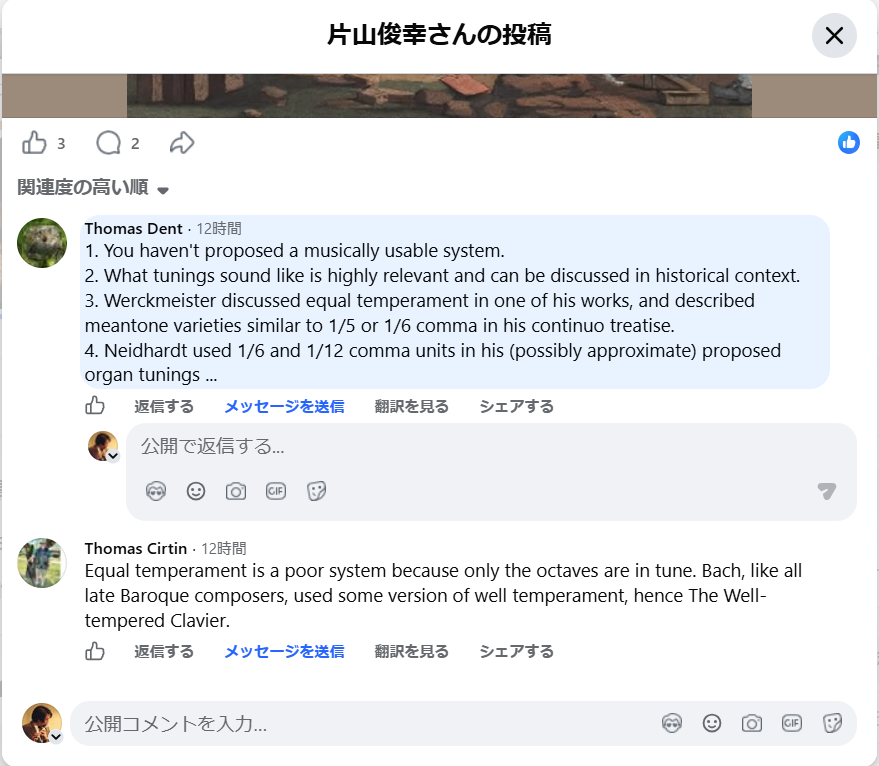
1. You haven’t proposed a musically usable system.
2. What tunings sound like is highly relevant and can be discussed in historical context.
3. Werckmeister discussed equal temperament in one of his works, and described meantone varieties similar to 1/5 or 1/6 comma in his continuo treatise.
4. Neidhardt used 1/6 and 1/12 comma units in his (possibly approximate) proposed organ tunings …
Thomas Cirtin
Equal temperament is a poor system because only the octaves are in tune. Bach, like all late Baroque composers, used some version of well temperament, hence The Well-tempered Clavier.
———-
The reactions to my recent posting, “The Collapse of the Lehman Hypothesis: Wishful Thinking vs. 18th-Century Common Sense”, have exposed something deeply fascinating—and profoundly disturbing.
What I once thought impossible has now manifested clearly before our eyes: the blatant collusion, cozy nepotism, and mutual back-scratching between Dr. Bradley Lehman and the administrators of these supposedly academic Facebook groups. We are witnessing the desperate, absolute subservience of the “Lehman cultists” to their guru.
Some members have shamelessly begged the moderators to purge this “foreign element” (myself, Toshi), while in certain groups, my direct replies to commentators were immediately hidden and censored by the administration. This is no longer a mere internet squabble; this is a crisis for the global early music community. It means that the iron-curtain censorship reminiscent of authoritarian regimes like Russia or China is now actively policing the discourse of Baroque music.
Then came the most comical farce of all. Dr. Bradley Lehman—a man who has virtually never “liked” anyone else’s posts in the history of these forums—suddenly hit the “Like” button on my article. For a fleeting second, I wondered if he had achieved a moment of profound self-reflection, and I doubted my own eyes.
But the illusion was brief. Shortly after, his panic set in. He unleashed a frantic counter-barrage, dumping a mountain of his own outdated essay URLs and PDFs into the thread. Has he completely forgotten that he has already bombarded me with these exact same links countless times before? There was absolutely nothing new. It was a visual wall of text accompanied by a comment that completely failed to answer a single, solitary line of the fatal mathematical contradictions I had posed.
Epilogue
Everything documented in this archive—from the raw, visceral 41-cent reality of Aron’s meantone to the acoustic necessity of the boy soprano—is rooted not in modern academic dogma, but in the physical, historical laws of sound. As a flauto traverso player who has spent years breathing life through these very intervals, I have simply let the sources speak, and the ears listen.
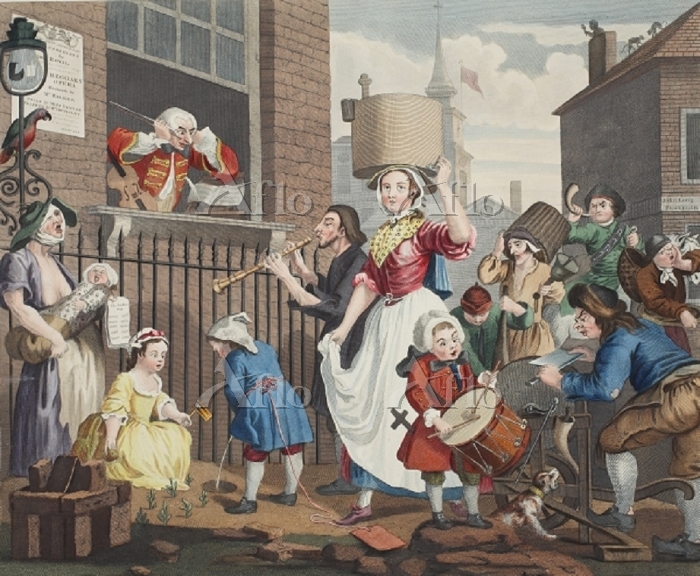
Yet, the response from the self-proclaimed “elite” of the modern early music establishment has been a spectacle of sheer panic. When I exposed the mathematical anachronism of Bradley Lehman’s tuning—challenging why he must flip Bach’s scroll upside down and force a modern 700-cent equal-tempered fifth into the Baroque grid—he and his supporters did not counter with numbers. They ran behind their group moderators, hid my comments, and threw children’s tantrums. They perfectly mirror the furious violinist in William Hogarth’s The Enraged Musician, desperately plugging his ears to shut out the physical vibration of reality.
This raving frenzy deepens when we touch the acoustic infrastructure of Bach’s vocal music. When I stated the self-evident truth that Bach’s church cantatas were scored for the fragile, ephemeral timbre of boy sopranos (trebles), the elite purists of the world’s largest “Johann Sebastian Bach” group and various “Early Music” forums immediately revolted. Hypocritically obsessed with original gut strings or woodwind replicas, they completely discard Bach’s primary original instrument—the boy soprano—in favor of modern female voices, and still call their recordings “authentic”. When cornered by this paradox, they abandoned historical logic entirely, escaping into modern political hysteria, labeling me a “misogynist” and screeching about “unjust child labor”.
My subsequent banishment (出入り禁止) from these so-called elite forums is not a badge of shame; it is my certificate of absolute victory. It proves that when text-bound dogmatists are confronted by an ear that understands physical resonance, they have no defense left but censorship.
They can hide my comments, and they can freeze my profile, but they cannot rewrite the physics of music. This page stands as the uncensored record of that clash. Let the cultists rave; the truth remains under the fingers, and in the air, unchanging.
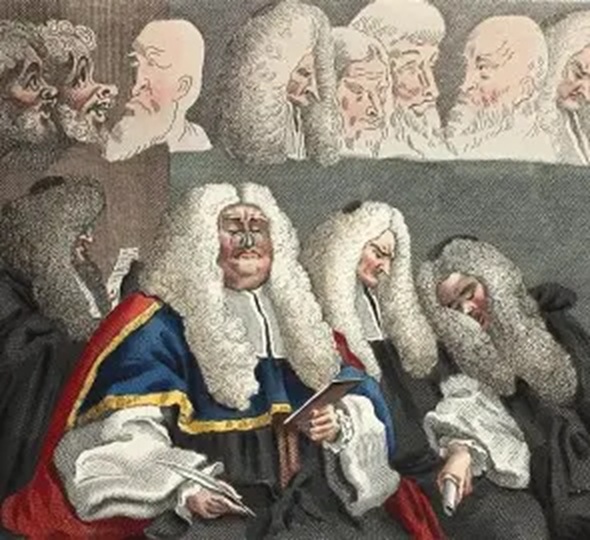
William Hogarth: “The Bench” (1758)A satirical masterpiece depicting dogmatic authorities buried in their texts, completely blind and deaf to the living reality around them. A perfect mirror to the modern early music establishment and the Lehman cultists, who resort to censorship and institutional sleep when confronted by the raw, physical laws of sound.