

Why don’t Westerners use “kaomoji”?
It would be more accurate to say they *cannot* use them, rather than simply *do not*. As you likely know, Western input systems rely entirely on “half-width(one-byte character)” alphanumeric characters. In fact, it is more accurate to say that the very concept of “full-width” characters does not exist for them. So, what exactly is “full-width”? Simply put, it is a concept that exists for the “Kanji cultural sphere”—specifically Japan, China, and Taiwan. (Incidentally, in Singapore, computers use 100% half-width input, so the situation is exactly the same as in the West.) This “full-width” format actually encompasses a vast array of symbol conversions. Consequently, only those three countries can use the same kinds of emoticons as Japan—such as (•_•) or (`・ω・´). How, then, do Westerners compensate for this? Since they are limited to half-width characters, the range of emoticons they can create is quite restricted. The emoticons they use are limited to things like “lol” or “:-)”. While “lol” serves a similar function to the Japanese “(wara)” (meaning “lol” or “haha”), it doesn’t exactly look like a laughing face. If anything, it looks more like the character Pinoko’s “Acchonburike” expression. There are others like “omg”, but that is merely an abbreviation for “Oh my god!” (Incidentally, “lol” stands for “Laugh Out Loud”). So, what do they use instead? They use the “emoji” invented by us Japanese. With the spread of smartphones, they too can now input symbols like 😂 or 😭 with a single tap from an “emoji panel”. An increasing number of Westerners are using them frequently on platforms like Facebook.
Input methods around the world
Western computers do not even have a “conversion” key. Their typing style is straightforward—what you type is what appears. You don’t see a long list of “conversion candidates” appearing below the text as you do on Japanese keyboards. The reason Japanese keyboards display these candidates is simply because the language has so many homophones (words that sound the same but have different meanings). So, given that Chinese and Taiwanese also have many homophones, do they use a “conversion key”? The answer is “No”. In fact, the surprising reality is that keyboard input in China has become “fully AI-driven”. No matter how long the text—and note that input relies on the Latin alphabet—AI instantly converts it without the need for a conversion key. The reason lies in China’s centralized system. Browsers like Baidu and IME software like Sogou are designed to automatically funnel text entered by the country’s 1.4 billion citizens into a state-run database. That is 1.4 billion people. As this data accumulates daily, the system can instantly predict how a sentence will continue and construct it on the fly—without a conversion key. Indeed, this AI-driven keyboard input is a driving force behind the development of China’s modern AI and robotics industries. It is said that AI’s strength lies in its ability to evolve in proportion to the square of the accumulated database volume. Furthermore, China is said to have compiled facial recognition data for nearly 100% of its 1.4 billion citizens. While we in Japan view this negatively as an “invasion of privacy”—a valid concern—it is also reported that crime rates in China have dropped dramatically as a result. AI has brought about miraculous advancements in areas ranging from the automation of transportation systems to the evolution of humanoid robots. Naturally, this includes military technology. Ultimately, all these cutting-edge Chinese industries trace their origins back to a single decision: adopting AI for PC keyboard input. In the early days of the PC, Chinese users struggled immensely with input methods; for a time, they relied on inefficient systems similar to Japan’s pre-war “Japanese-language typewriters”. It is no exaggeration to say that, in an effort to break free from this, they staked everything on AI and state control.
Regarding Taiwan, they did not employ AI in the same way China did; their approach was closer to Japan’s, so I will not elaborate on it here. As I have previously mentioned, the Japanese created a major innovation in the form of the keyboard’s “conversion function”. However, the Japanese people became “satisfied” with it—this occurred back in the 1990s. Because Japan’s input system was so “convenient and well-designed”, it ceased to evolve during that period; in other words, the process of “Galapagos-ization” became complete. The system—which utilized a “conversion key” to switch between *kanji* (ideograms), *hiragana* (used for *okurigana* or grammatical endings), and *katakana* (used for loanwords)—had achieved what could be considered a “completed” or “ideal” form, thereby leaving no room for AI to play a role. I hope that through this explanation, you will fully grasp the reality that Japan has fallen “laps behind” China in the fields of AI and humanoid robotics.
Chinese Humanoid Robots
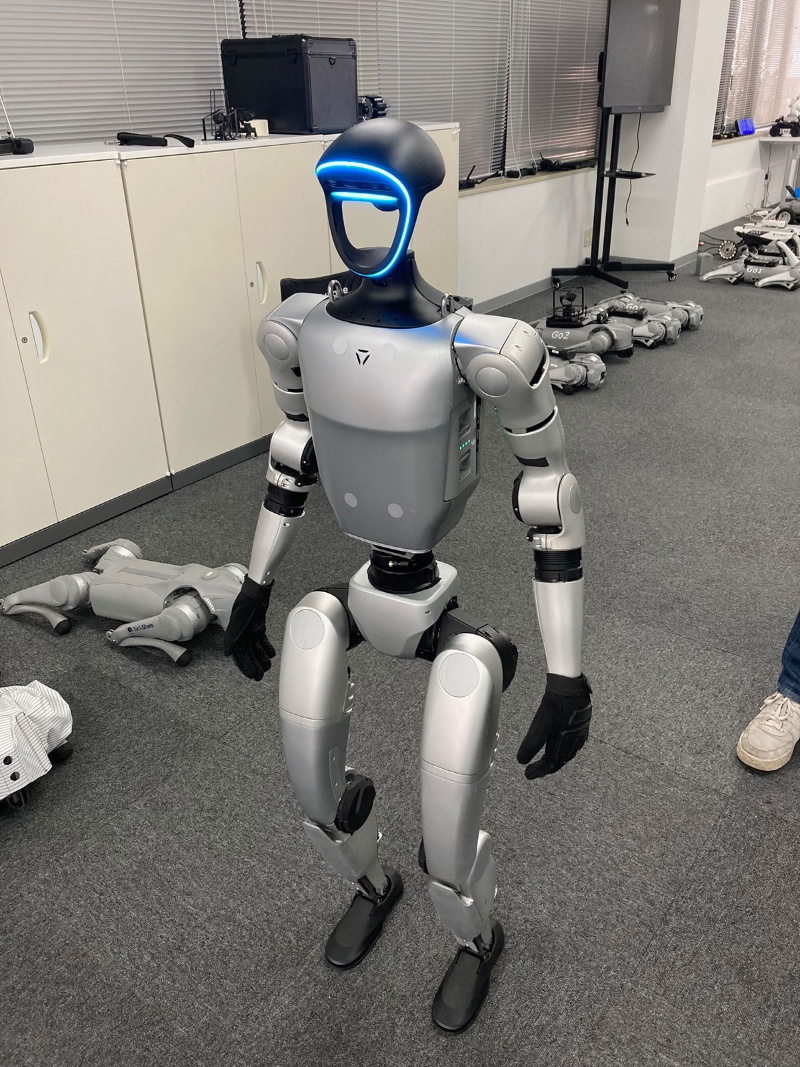
“Why is it necessary to make robots humanoid?”… There are some Japanese people who nitpick Chinese robots, almost as if out of sour grapes. I simply cannot fathom why Japanese people—who surely grew up dreaming of a world where humanoid robots like *Astro Boy* played an active role—would say such foolish things. To me, it looks like nothing more than jealousy toward China. Japanese people tend to deliberate thoroughly before taking action. Chinese people, on the other hand, start acting while they are still thinking. They do not fear failure, nor do they view it as shameful. Come to think of it, Japan used to be like that, too. That is how we created so many excellent products (such as the “Washlet”). Yet now, we have been completely overtaken. In a video from the Robot Olympics, there was a robot that, after running the 100-meter dash, crashed into a wall and burst into flames. Upon seeing this, “certain” Japanese people laughed. However, the Chinese engineer who built that robot declared, “We will definitely improve it next time”. He said it with a serious face—with resolve. And in all likelihood, he will actually pull it off in the near future. I find them to be a formidable people. Can Japan really survive if it makes an “enemy” of such a nation? I have serious doubts.
Japanese Culture as a Global Standard
Here is some good news for the “net-right” crowd as well: there are “global standards” created by the Japanese. Examples include the pictograms for pedestrians at traffic lights, the “EXIT” signs in movie theaters, and the “restroom” symbols in department stores. I have seen many similar designs in Germany. These were actually created around the time of the 1964 Tokyo Olympics, born from heated debates among designers gathered from across Japan. Today, they are used all over the world. This success stems from the “wise decision” by Japanese designers to waive their copyrights—much like when the Dutch company Philips waived its copyright for the cassette tape. Japanese people of the past possessed that kind of vitality. However, it is no exaggeration to say that the Japan of today is a mere shadow of its former self.
The Japan of Yesteryear
When Honda first unveiled its bipedal robot “ASIMO”, the world hailed Japan as the “land of the future”. Today, however, Japan’s development of humanoid robots has effectively stalled, while China is forging ahead with a state-backed push for mass production and commercialization. Why have the Japanese—once the people of “Astro Boy’s land”—come to disparage humanoid robots and mock China’s failures? Let us examine the “Japanese pathology” and “Chinese strength” underlying this mindset from three perspectives.
1. Why do some Japanese people disparage the concept, claiming there is “no need for a humanoid form”?
The arguments they raise—such as “four-wheeled vehicles or conveyor belts are more efficient” or “there is no point in a humanoid shape”—are essentially born of envy (the “sour grapes” mentality). By convincing themselves that the cutting-edge technology they can no longer match (China’s humanoid robots) is “useless” or “lacks practicality”, they attempt to justify their own lag and maintain their peace of mind. Yet, why *must* the robot be humanoid? The reason is clear: every house, factory, staircase, doorknob, and tool in this world is designed to fit the size and shape of a human being. A humanoid robot can step in and work in place of a human without requiring a single millimeter of modification to existing infrastructure. Chinese engineers are racing forward with their sights set on the massive future market offered by this “ultimate versatility”.
2. Japan “laughs at failure”, while China “turns failure into an asset”
A culture has emerged—visible on Japanese social media—of laughing at videos of robots falling over or catching fire and declaring, “See? Chinese-made products are no good”. This stems from the fact that Japan has become a society obsessed with a “deduction-based” mindset (where one is penalized for errors rather than rewarded for innovation). In Japan today, the starting point is a perfect score of 100; a single failure drops you to zero—a fatal blow. Consequently, the mindset is: “To avoid anyone having to take the blame, we won’t move until we’ve deliberated to perfection” (by which point it is often too late). In contrast, China starts at zero; with every failure, they accumulate data, raising their score to 10, then 50, and so on. For engineers, data from a robot that has burst into flames serves as a premier textbook, teaching them exactly which parts were under stress and how to control the system to prevent future breakdowns. Because they view failure as an asset rather than a source of shame, they can earnestly declare, “We’ll improve it next time”. Faced with this overwhelming speed—and the sheer volume of trial-and-error cycles—Japan, with its habit of over-deliberation, has been left laps behind.
3. The Japan of the past (the “Washlet” era) was just like China
The true irony is that Japan once possessed that very same energy—a fearlessness regarding failure—that characterizes China today. There are famous stories from the time TOTO was developing the Washlet, involving employees repeatedly conducting experiments amidst the stench of feces to gather data on the precise positioning of the human posterior. Then there is the story of Sony pushing ahead with the Walkman despite being told that a device for listening to music while walking would never sell. Back then, Japan, too, astonished the world with innovations driven by incredible speed and decisive action, even while the West mocked its products as cheap imitations that would break down in no time. Perhaps Japan has become so prosperous that the fear of losing what it has has stripped it of its drive to take on new challenges.
My commentary today started with a discussion on emoticons and evolved into a discourse on the nature of nations. I wonder what you all thought of it… #China #Keyboard #West #Emoji #AI #HumanoidRobot